
📋 Article outline
One in four new bikes is now electric
Vietnam has more than 84 million registered motorcycles and mopeds under management, according to Traffic Police Department figures released on 8 July 2026. In the first half of this year alone, 1.83 million new motorbikes were registered. Within that new-bike flow, electric bikes are no longer a minority. According to Motorcycles Data figures cited by domestic media in August 2026, more than 513,000 electric motorbikes were sold nationwide in the first seven months of the year, up 97% year-on-year and accounting for about 28% of total motorbike sales. For full-year 2025, the figure was 700,000 bikes, putting Vietnam in third place worldwide for electric-motorbike consumption, according to VnEconomy.
But at the same time, the biggest policy milestone has had to slip. Directive 20/CT-TTg, dated 12 July 2025, set a target that by 1 July 2026 there would be no more petrol motorbikes inside Hanoi's Ring Road 1. In practice, by that date the city had only piloted the restriction on about 1.65 km² of core Hoan Kiem, limiting private vehicles on weekends; petrol-powered app-based bikes are only banned from 1 January 2027, and the full Ring Road 1 ban has slipped to 2028, according to the scheme the city's People's Council passed on 15 June 2026 and reporting by Tuổi Trẻ and VietnamNet. Ho Chi Minh City is now seeking public comment on a draft requiring two-wheeled app-based vehicles in its central zone to switch to electric from 1 January 2028.
Reading these two sets of numbers side by side, one thing is clear: people have been buying electric bikes faster than infrastructure has kept pace. The milestone slipped not for lack of bikes, but because there was not yet a place where someone riding all day could reliably recharge that bike.
Battery swapping today: covering points, not yet covering journeys
For electric motorbikes, battery swapping is the best-suited way to recharge for high-mileage riders: two minutes instead of two hours. The question is where the existing swap network actually sits. We have compiled the verified figures:
- V-Green announced about 4,500 swap cabinets in January 2026, with a target of 150,000 points within three years, according to Vietnambiz. That target is more than thirty times the current number.
- Selex Motors has about 118 stations in Hanoi, Ho Chi Minh City and Hue, with a target of 1,000 stations, according to an AutoPro roundup from May 2026. Three of those stations are located at Petrolimex fuel stations, shared across multiple brands, with a swap taking about two minutes, according to ZNews.
- Honda Vietnam began operating swap stations in Hanoi from 4 June 2026 for its removable-battery models, with a target of about 50 stations in Hoan Kiem in Q3 2026 and about 1,000 points across Hanoi by 2027, according to the company's own announcement and AutoPro.
- Ho Chi Minh City has 2,459 swap points, of which more than 1,500 cabinets are located on sidewalks, according to the same roundup.
Three points need to be said plainly. First, almost all of this infrastructure sits in the two big cities. A rider going electric from Bien Hoa to Da Lat, or from Hai Phong to Nam Dinh, has no station yet to count on. Second, each brand runs its own battery standard: one brand's cabinet will not accept another brand's battery, except at the three shared Petrolimex stations. A national standard for swappable batteries for motorcycles and electric motorbikes is still being drafted, according to the Vietnam Standards and Quality Institute. Third, most cabinets sit on sidewalks and at convenience stores, with no seating, no restroom, no attendant on site. They cover points on a map, but not yet a rider's journey.
User numbers make this gap clear. Ho Chi Minh City's scheme estimates about 400,000 app-based drivers and delivery riders covering an average of 80 to 120 km a day, according to Tuổi Trẻ. A common electric-motorbike battery today runs 120 to 200 km, per manufacturer figures. That means someone riding for a living needs to swap or charge at least once a day, at a place they know in advance has a full battery — and ideally a place that also has drinking water, a restroom and shade.
Three things a wide-reaching swap infrastructure needs
From what has happened so far, we draw three conditions for battery swapping to reach beyond the two cities.
A shared battery standard. When a station's cabinet accepts batteries from multiple brands, each station can serve many more bikes, and the cost per swap falls. The three Petrolimex stations are small evidence of this direction. The national standard now being drafted will decide how fast the whole market can expand.
A site with power, an attendant and amenities. A swap cabinet needs a stable power supply to charge multiple batteries at once, a location that is fire-safe, and someone on hand to deal with a jammed battery or a faulty cabinet. A sidewalk cannot provide all three. A fuel station, a restaurant, a parking lot, a rest stop can.
A network built along corridors, not administrative boundaries. Road users do not live inside one district. Stations need to run one after another along national highways, at city gateways, through industrial zones and out to communes and wards, so an electric bike can leave the city without turning back.
Next-generation batteries and a diverse product line for consumers
Battery technology is moving faster than many people think. CATL announced its Naxtra sodium-ion line entering mass production from June 2025, with an energy density of 175 Wh/kg and a lifespan of over 10,000 cycles, usable with swap systems as well. Yadea introduced sodium-ion batteries for two-wheelers that charge to 80% in 15 minutes and retain over 92% capacity at minus 20 degrees Celsius, according to Báo Xây dựng. In Vietnam, Honda sells LFP-battery models with a range of about 120 km, and Dat Bike has released a model with a 200 km range per charge. Sodium-ion batteries are cheaper in raw materials and safer thermally, but in the sources we found, no sodium-ion model is yet officially sold in Vietnam.
On the product side, a nationwide green transition cannot run on a single type of bike. An in-city delivery rider, a farmer hauling goods to a district market, an industrial park shuttling workers, a tourist area carrying passengers — each needs a different bike, but ideally all sharing one battery standard. That is why we chose to introduce the BRIZ electric vehicle line through the CD GO channel. According to the manufacturer's February 2026 catalogue, the line comprises 21 models: electric motorbikes, electric bicycles, three-wheelers for passengers and cargo, and four-wheelers, with 11 models using swappable batteries. Most bikes share a common 72V battery, 35 Ah each, with several lines carrying two batteries. The smart swap battery has an integrated battery management system with 4G and GPS tracking, IPX7 water resistance, and active cell balancing. The swap station in the same system has 9 bays, water-cooled fast charging, NFC unlocking, smoke and temperature sensors, circulating-water fire suppression, and runs 24/7. The catalogue does not disclose pricing, so we do not state prices either; full specifications are on the BRIZ Electric Vehicles page.
One more thing consumers should know when choosing a bike: since 1 January 2024, manufacturers and importers of batteries and accumulators have been required to fulfil recycling obligations under extended producer responsibility (EPR) regulations. Batteries concentrated at swap stations are easier to collect and recycle than batteries scattered across individual bikes. That is another reason to favor the swap model.
Welfare rest stops are where this infrastructure belongs
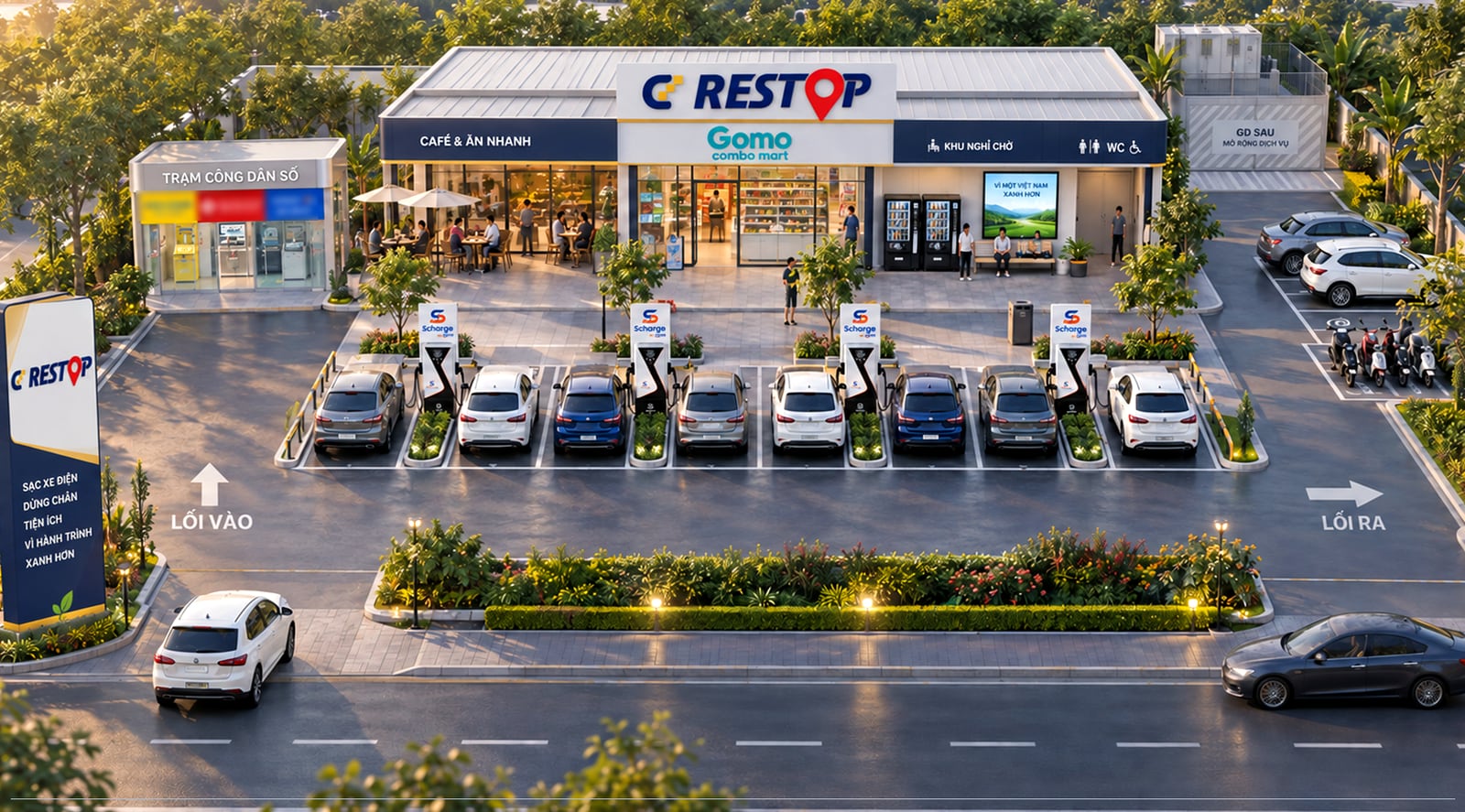
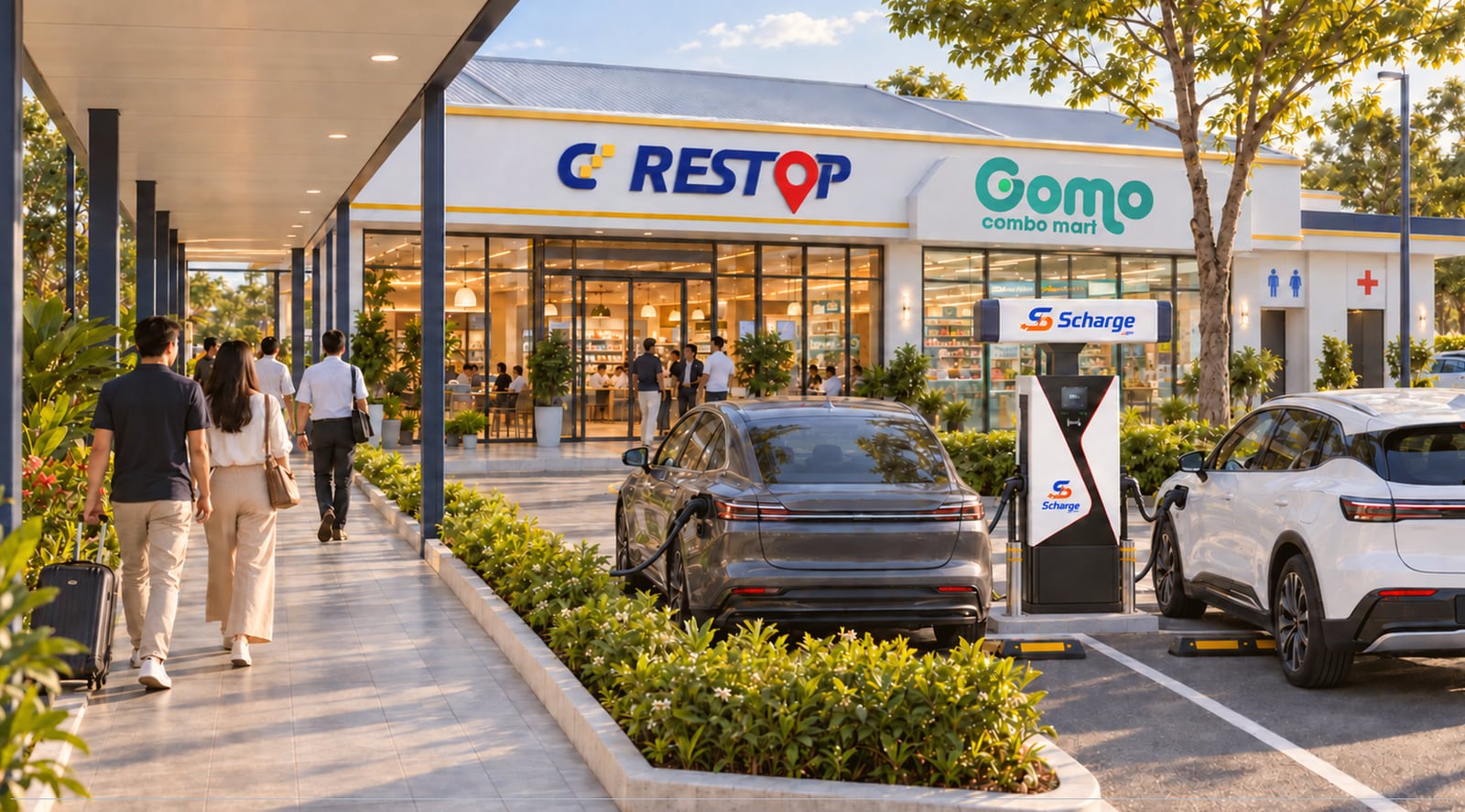
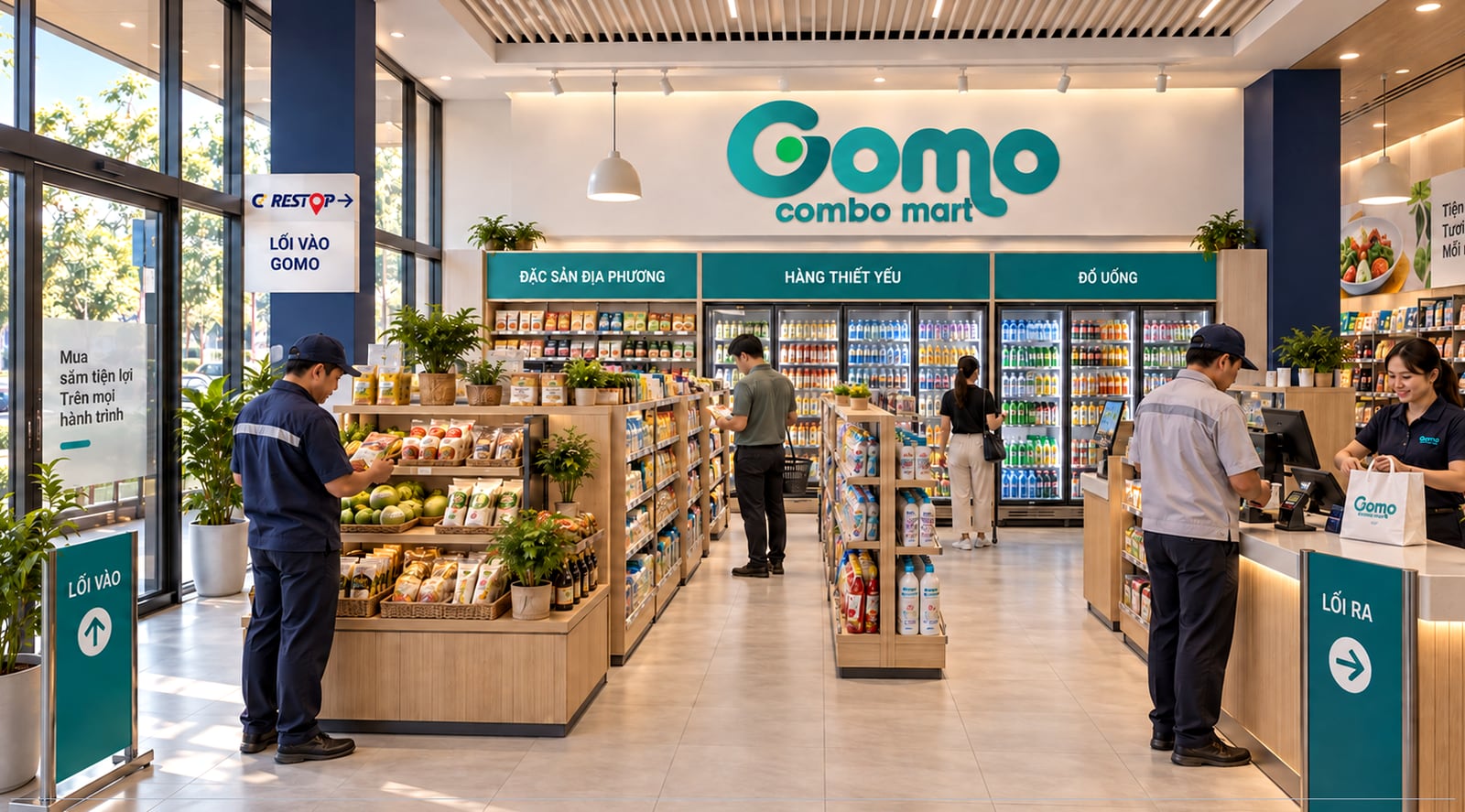
We do not make batteries and we do not make bikes. We build the place to put a swap cabinet, and everything around that cabinet. In our design standard, every rest stop is assembled from five modules that can be added or removed without altering the rest; the battery swap station is one of those five modules, with its own requirements for load-bearing flooring, forced ventilation and fire separation for the battery zone. At a Class C affiliated stop, on a partner's existing site such as a fuel station, restaurant, parking lot or community hall, the swap cabinet comes with the minimum components of the Five HAVEs standard: a service counter, charging posts, a compliant restroom, free drinking water and a policy notice board. At a Class B stop at an urban gateway, riders also get coffee, fast food, a wifi waiting area, and a GOMO Mart selling essential goods at stabilized prices. At larger stops there is a driver rest room, a shower and laundry area, and a first-aid corner.
The regulatory framework is pulling in the same direction. On 17 August 2026, the Vietnam Road Administration required rest stops to complete their EV charging systems before 1 January 2027, with at least 10% of parking spaces equipped for charging under QCVN 43:2024/BGTVT, and encouraged operators to go higher, according to Báo Chính phủ. Charging at rest stops is now mandatory; battery swapping for two-wheelers at rest stops is the next step we want to take first.
We want to state our limits clearly
A network of 34 provinces and cities, 500 rest stops and 14,000 satellite charging points is the target of the Scharge Project, not its current state. We do not yet have a single site operating a battery swap station. The swap-station counts for other brands cited in this article are the numbers they announced at the time reported by the press, and figures of 50,000, 150,000 or 1,000 stations are each brand's own target. A shared battery standard does not yet exist; once the national standard is issued, we will design our swap bays to that standard.
What we do have is a completed design standard with a battery swap module, a vehicle line sharing a common battery standard, agreements signed on 9 September 2026 covering the charging platform, equipment, land bank and on-site services, and an eight-step process from site acquisition to operation.
An invitation
If you are a vehicle or battery brand looking for a site to place a swap cabinet with power, an attendant and amenities around it, we are open at every class of stop. If you own a fuel station, restaurant or parking lot in a district along a national highway, you are holding a missing link in the nationwide swap network. If you are a locality worried that residents are buying electric bikes with nowhere to recharge, let us survey and rank the site before you draw anything up.
A delivery rider leaves Hoan Kiem after 1 January 2027 on his first electric bike. We want it so that when his battery runs low at kilometer ninety, he knows for certain how far the next station is, that a full battery is waiting there along with a glass of water and a seat, and that two minutes later he is on his way again.
For site and battery-swap infrastructure partnerships: hotline 0981 107 900 · email hi@cdrestop.com.
Read more: BRIZ Electric Vehicle Line via CD GO · Rest Stops in the Heart of the City for App-Based Drivers.