
📋 Article outline
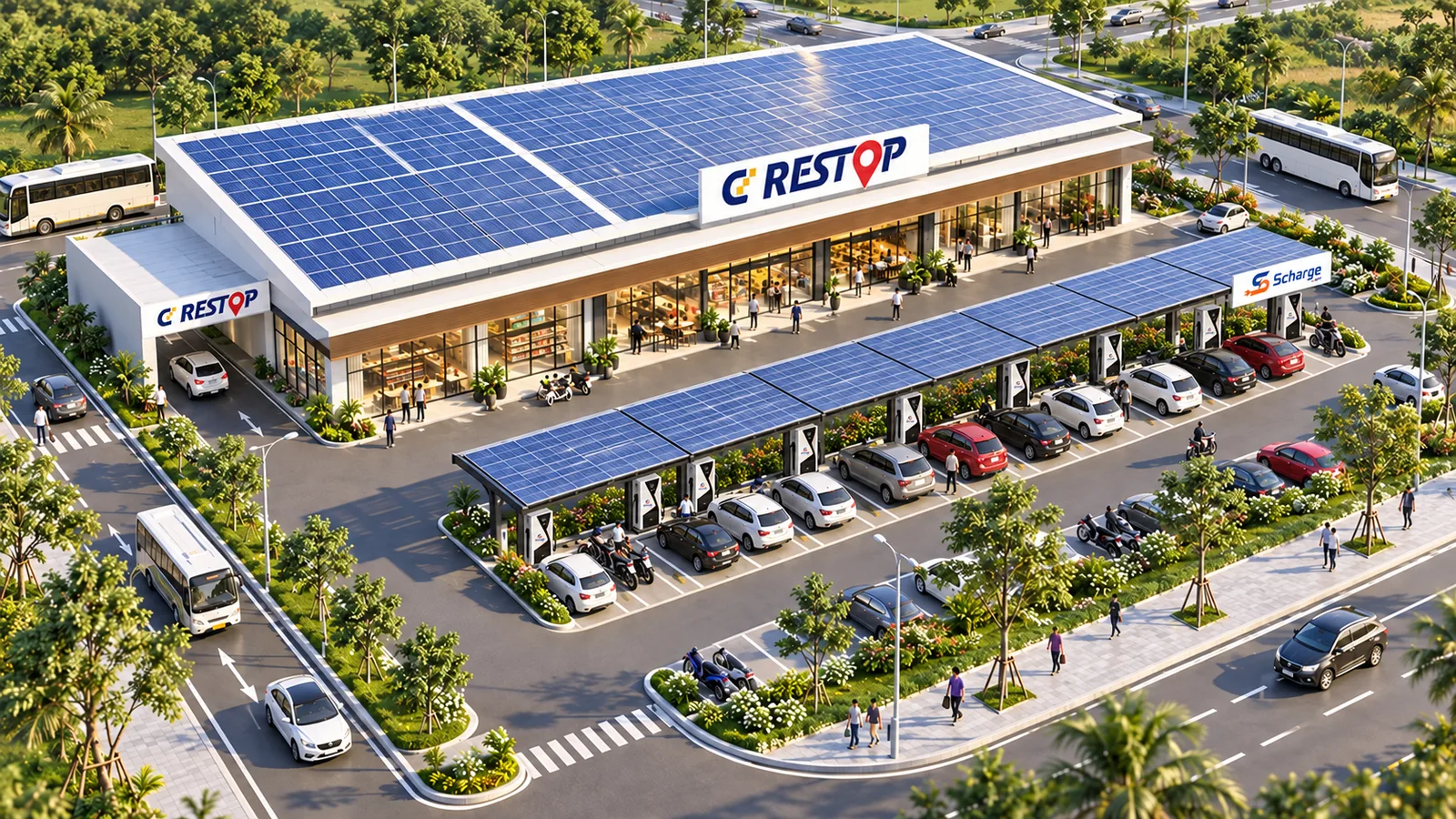
Four hours at the wheel, then where do you stop?
A container driver leaves the port at midnight. He knows the law. Under Decree 168/2024/ND-CP, in force since 01/01/2025, drivers of commercial and in-house transport vehicles may not drive continuously for more than 4 hours, more than 10 hours a day or more than 48 hours a week. Go beyond that and, under the same decree, the driver is fined 3 to 5 million dong and loses 2 points on the driving licence. A vehicle owner that is an organisation and lets the violation happen faces a fine of as much as 8 to 12 million dong.
Four hours pass. He has to stop. The question is where. The roadside is not safe. A petrol station has nowhere to lie down. An empty lot has no toilet. The cab becomes the bed. The meal is a rice box bought in a hurry.
The same night, a family of four drives an electric car back to their home town. The child needs a toilet. The car needs a charge. The parents need a coffee and a clean seat for thirty minutes. They ask the same question.
These two groups need the same thing: a rest stop where they know in advance what they will find. We wrote this article to answer why rest stops must be standardised nationwide, and how service quality changes once they are.
Rest stops today
Start with the number of vehicles. According to the Traffic Police Department, Ministry of Public Security, the country had 7,134,939 automobiles under management as of 30/6/2026. In 2025 alone, 624,300 automobiles were newly registered, up 27% from 491,400 in 2024, as the Traffic Police Department announced on 26/12/2025. From the same source, trucks and container trucks grew fastest: over 122,000 newly registered in 2025, up 35% from 89,943 in 2024. Each of those vehicles means a driver who must stop and rest as the law requires.
Family car ownership is rising too. According to the General Statistics Office, 9.0% of households owned a car in 2024, or about 2.53 million of the country's 28.1 million households, compared with 5.7% in 2019. In 2025 the country recorded 135.5 million domestic tourist trips, according to the Ministry of Culture, Sports and Tourism.
Infrastructure has not kept pace. The country had about 3,000 km of expressway in operation in 2025, with a target of 5,000 km by 2030 under the Government's direction. On the eastern section of the North-South expressway, 36 rest stations are planned, according to the Vietnam Road Administration. As of 2/9/2026, also according to the Road Administration, 20 of the 21 stations in the current contract batch were providing essential services, but only 2 were fully completed.
Figures are one thing. Below is a coastal site in the South Central region that we visited for a survey. We have not built anything here and have made no investment decision. The photos only record what is already there.
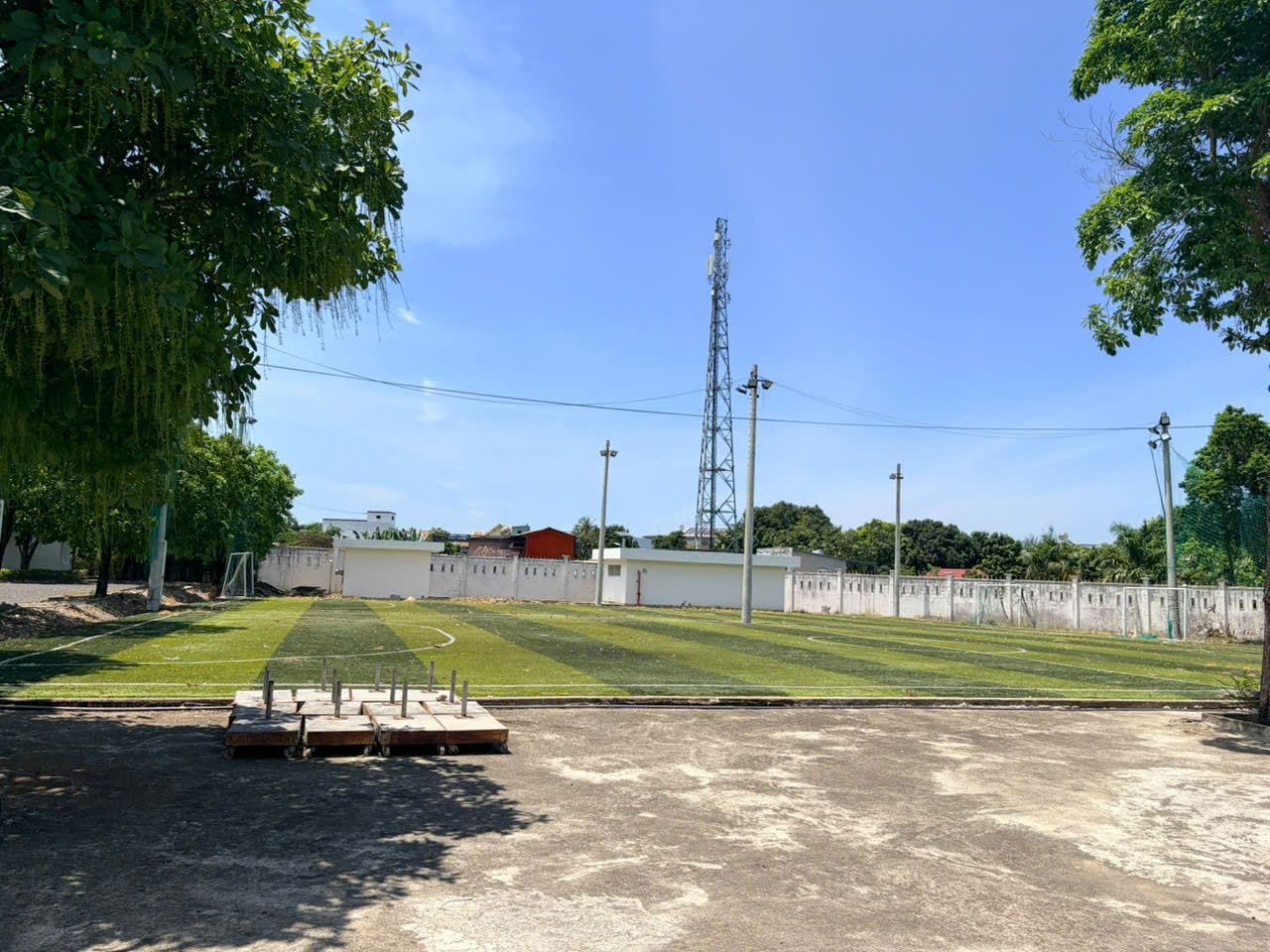
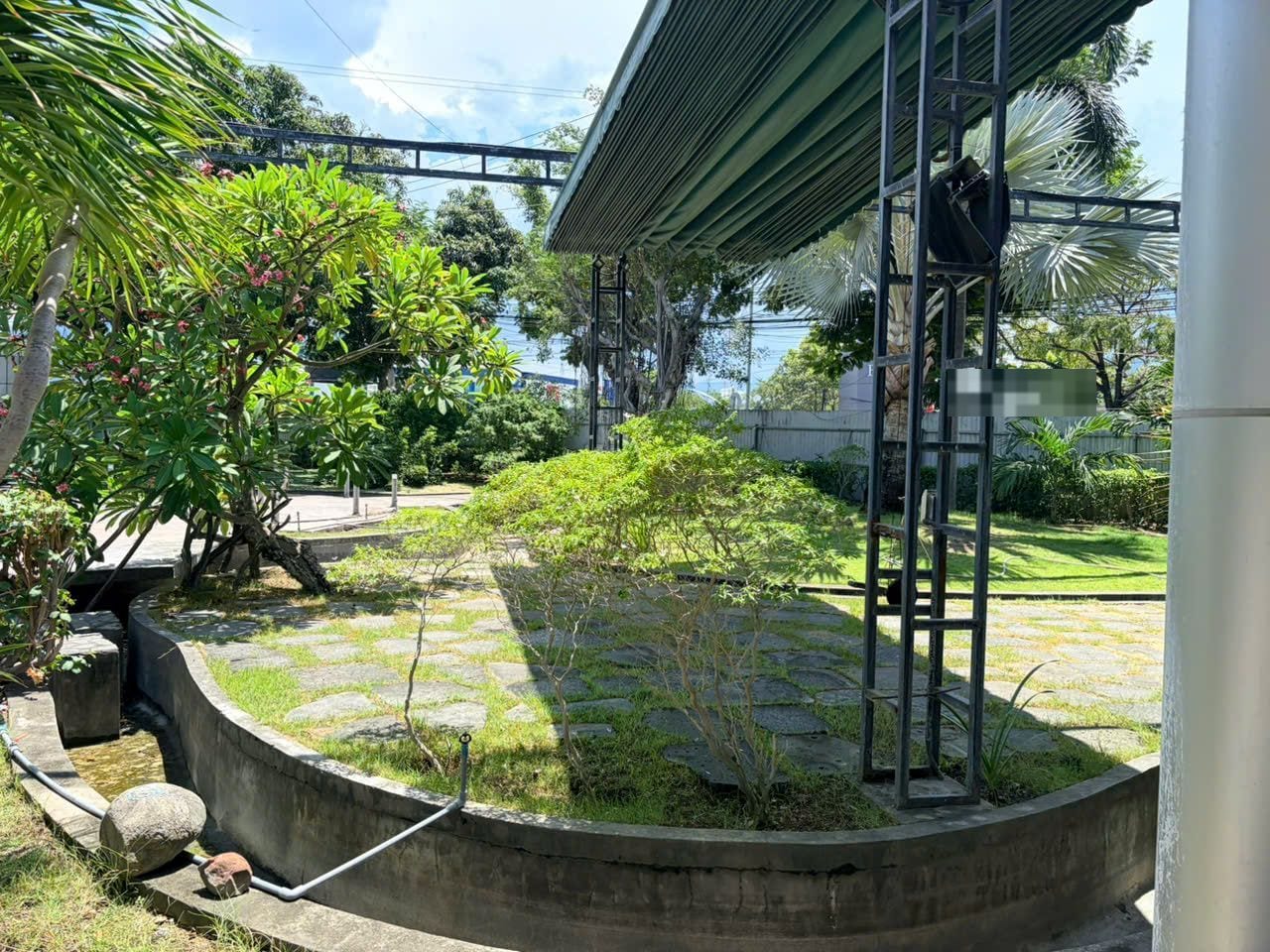
This site has a large yard, a garden, a perimeter wall and trees. But nothing in the photos serves a person who has just driven four hours. No separate parking for trucks. No chargers. No rest area for drivers. That is the picture at many roadside sites today. There is land, there are buildings, but there is no standard. And because there is no standard, nobody stops.
Why it must be done now
One. The law has made rest breaks an obligation
Since 01/01/2025, under Decree 168/2024/ND-CP, rest breaks are an obligation backed by penalties. The Road Law 2024 and the rest station standard QCVN 43:2024 also require rest stations to have charging systems, according to the Vietnam Road Administration on 2/9/2026. But a rule can only be enforced when drivers have somewhere to comply with it. Our design standard uses a spacing of 60 to 100 km between two sites on the same corridor as the basis for siting. We state this clearly: this is a parameter of the CD Restop design standard, not a figure published by a state agency.
Two. The driver shortage crisis
According to the Vietnam Automobile Transportation Association on 15/7/2026, 25 to 30% of tractor trucks sit idle in yards because there are no drivers. North-South transit time has stretched from 36 to 48 hours to 72 to 96 hours, also according to the Association. As transport companies told the press in July 2026, container driver pay has reached 30 to 50 million dong a month and they still cannot hire. On every trip, drivers wait 8 to 10 hours at ports and warehouses, according to the same reports. What is missing is not money. What is missing is a decent place to sleep, a shower, a hot meal and a proper place to wait on the road. Transport companies themselves, according to the press in July 2026, have asked for investment in rest stations and logistics infrastructure.
Three. Families are not being served
From what we have seen on the routes we surveyed, no chain of rest stops has been designed for a family stopping for thirty minutes with a clean toilet, space for children and a decent meal. Families travel in waves at weekends, on holidays and at Tet. Professional drivers travel steadily all year round. The two groups balance each other's rhythm. A site that serves both will not be empty on weekdays and will not be overloaded on holidays.
Four. The charging bottleneck and slow expressway infrastructure
According to industry data compiled up to May 2026, there were 374,816 electric cars on the road nationwide. For an EV owner with no charger at home, every charge means driving to a public charging point and waiting. From what we have observed, what discourages users is not a lack of chargers. What discourages them is waiting time with nothing to do. We are not competing for space on the expressways. We look at the places no plan has yet reached: urban gateways, port clusters, industrial parks and affiliate points down to wards and communes.
What standardisation means
Standardisation means knowing in advance. Knowing what the next site will have: a toilet with no fee, meals at a listed price, a charger that works with your car. Standardisation is also what makes replication possible: one design that can be repeated across many provinces and cities, with the same yardstick for costing, construction and acceptance.
The CD Restop design standard divides every site into four tiers. The tier decides the scale of investment, the electrical configuration and the list of modules, so the tier must be set before any drawing is made. Every area below is a parameter of the design standard, not the area of an existing site.
- Complex: 3,000 to 5,000 m². At international ports, transport hubs and key national interchanges. Includes logistics, accommodation, a large restaurant and a high-capacity charging complex combined with solar power.
- Tier A: 1,500 to 3,000 m². At key national or regional transport hubs. Includes a food court, a driver recovery area, union and welfare space, and a multi-charger cluster.
- Tier B: 500 to 1,500 m². At urban gateways and major interchanges inside and outside the city. The charging station is the focus, with coffee and fast food, a waiting area with wifi, and standard toilets with no fee.
- Tier C: under 500 m². This is an affiliate point, not a site where we invest in the whole premises. We work on a partner's existing premises: a shop, a car park, a petrol station, a community hall, a local market or a residential area. It has mini chargers that run unattended, a community digital notice board, a digital citizen counter and a vending machine. No shop is placed at an affiliate point. Our installations are removable, do not alter the partner's building structure and have their own meter.
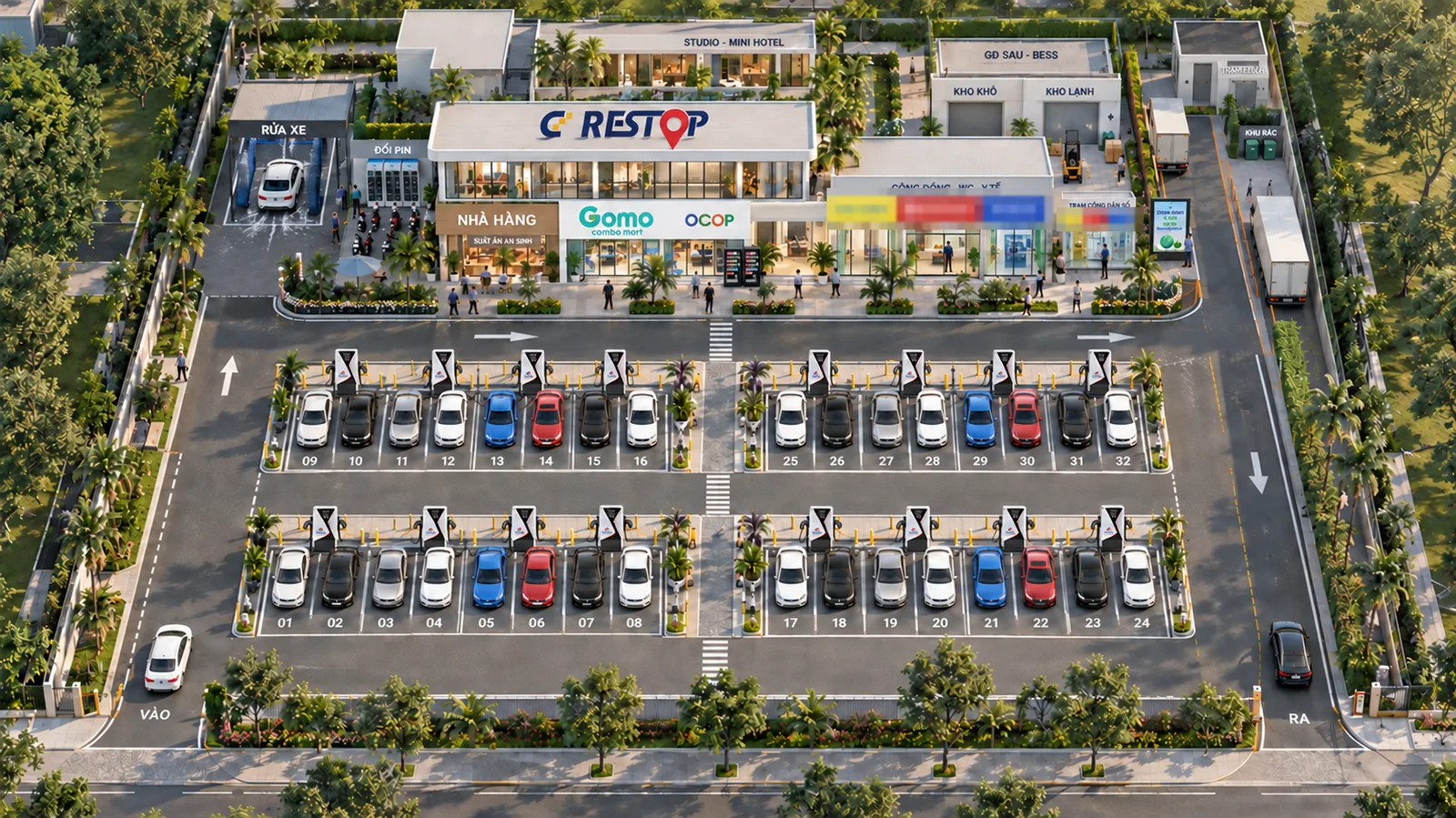
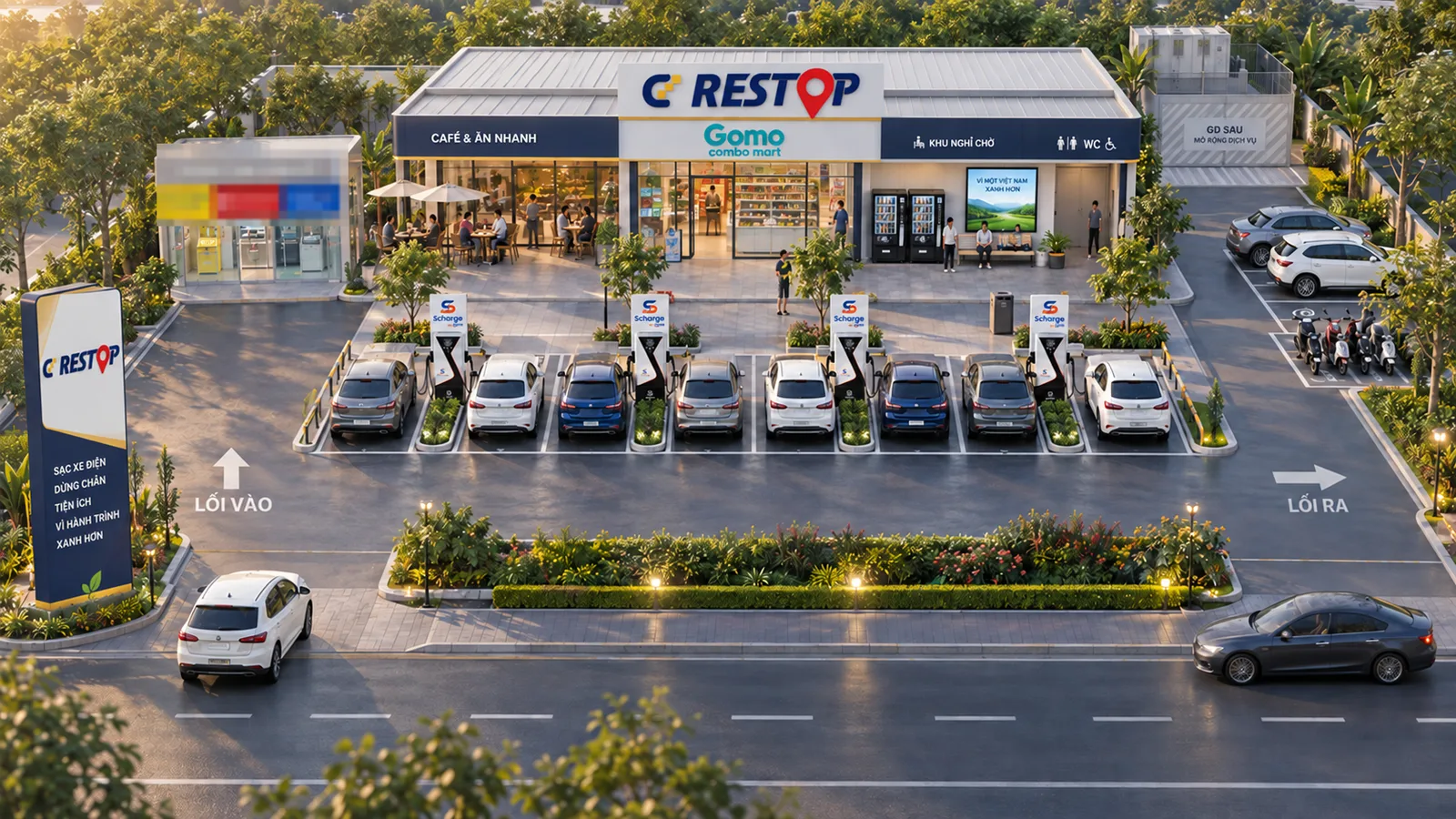
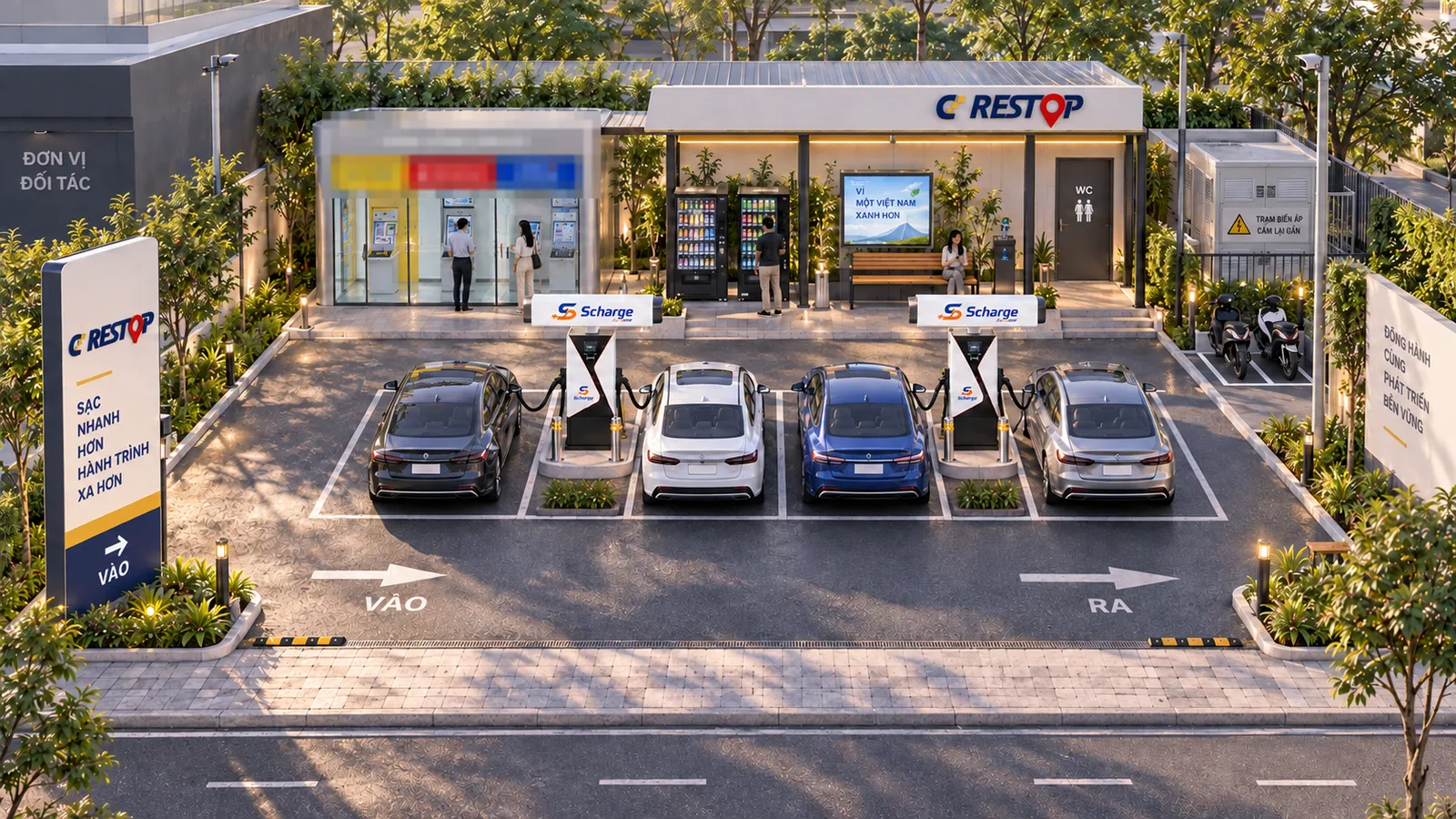
All four tiers share one principle: phase 1 must be able to operate independently, with its own low-voltage substation, the first batch of chargers, a parking yard, entrance and exit, an operations building, toilets, lighting and signage. No site draws power from a neighbouring building. Modules not yet built must still have space, conduits, cable trenches and connection points reserved.
The design standard sets out five modular add-ons by tier:
- Digital citizen station and vending: mandatory at all four tiers. At affiliate points, a vending machine replaces the shop.
- Accommodation: mandatory at Complex and Tier A. Tier B reserves the space.
- Car wash and battery swap station: mandatory at Complex. Tier A and Tier B reserve the infrastructure.
Every tier follows the same common standards: QCVN 43:2024, fire safety, food safety, accessible design for people with disabilities, and on-site solar power combined with storage. And a service commitment we call "5 CÓ", five things every site must have, applied from the largest site down to the affiliate point:
- MUST HAVE clean energy: chargers and on-site solar power.
- MUST HAVE meals and essential goods at welfare prices: meals at listed prices, essential goods at stabilised prices.
- MUST HAVE safe digital financial services: a digital finance kiosk right at the site.
- MUST HAVE community life: space for community organisations, a policy notice board.
- MUST HAVE welfare for people on the road: standard toilets with no fee, free drinking water, a rest area for drivers.
How standardisation changes the service
Standardisation means a person stepping out of the vehicle gets exactly what they need, at any site. Every image in this section is a proposed rendering from the design documents, not a photo of an operating site.
For long-haul drivers
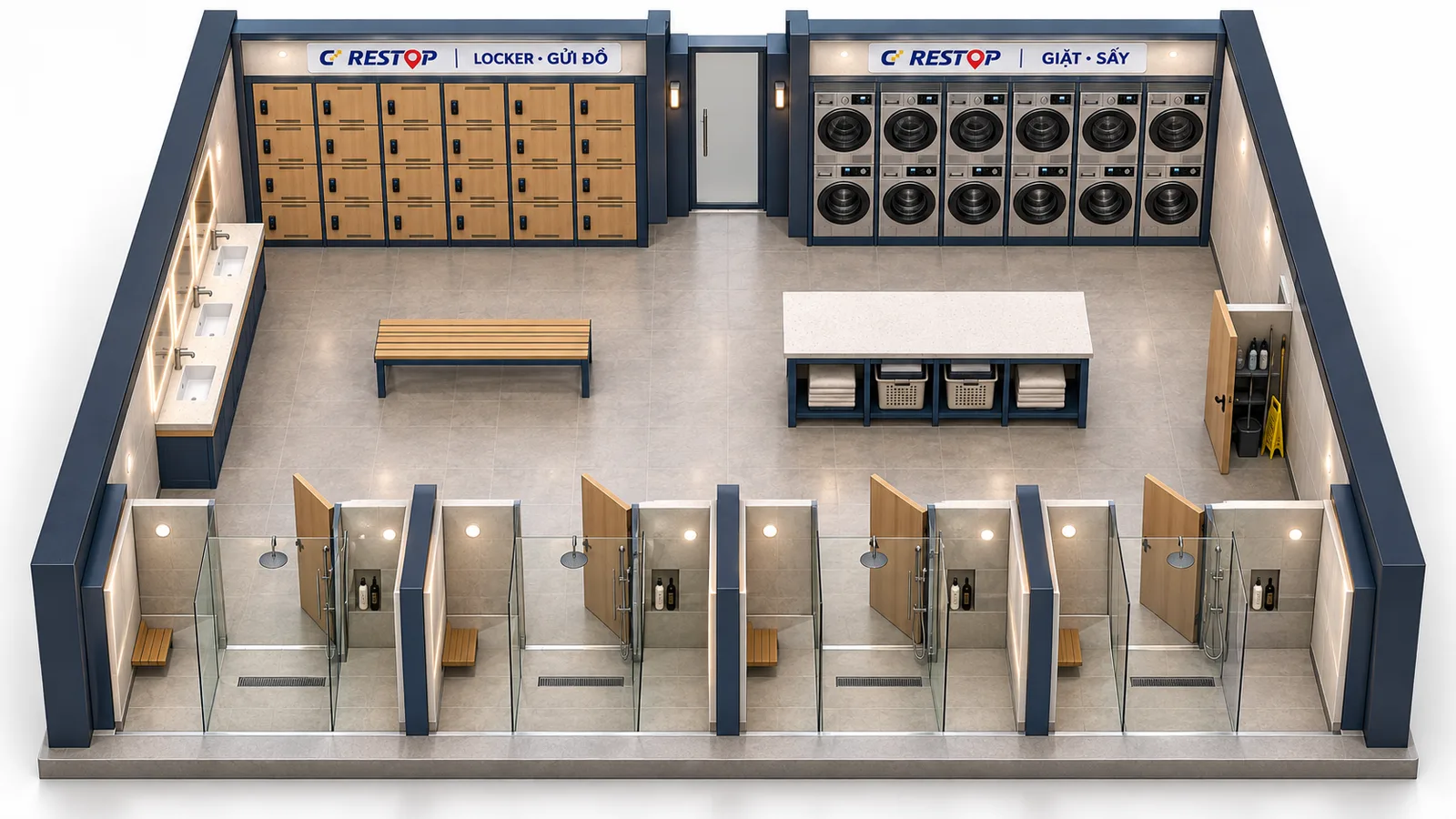
Drivers do not have to sleep in the cab. The driver rest room under the design standard has individual sleeping berths, curtains and lockers. Next to it is a shower, laundry and locker area with private shower cabins, washing machines, dryers and storage lockers. These two areas are placed at Complex and Tier A sites, next to a medical corner with a first aid cabinet. That is how the four-hour rule of Decree 168/2024/ND-CP becomes something a driver can do instead of a fine.

Meals and essential goods
The food block is designed around a one-way flow kitchen that meets food safety standards. The welfare meal counter lists its prices openly. Drinking water is free. A basket of essential goods is sold at stabilised prices. The same kitchen block serves both long-haul drivers and families.

The GOMO convenience store is part of the design for Tier B, Tier A and Complex, selling welfare goods and local specialities. There is no shop at a Tier C affiliate point. Shopping needs there are met by the partner's own facilities, and we place a vending machine.
Scharge charging
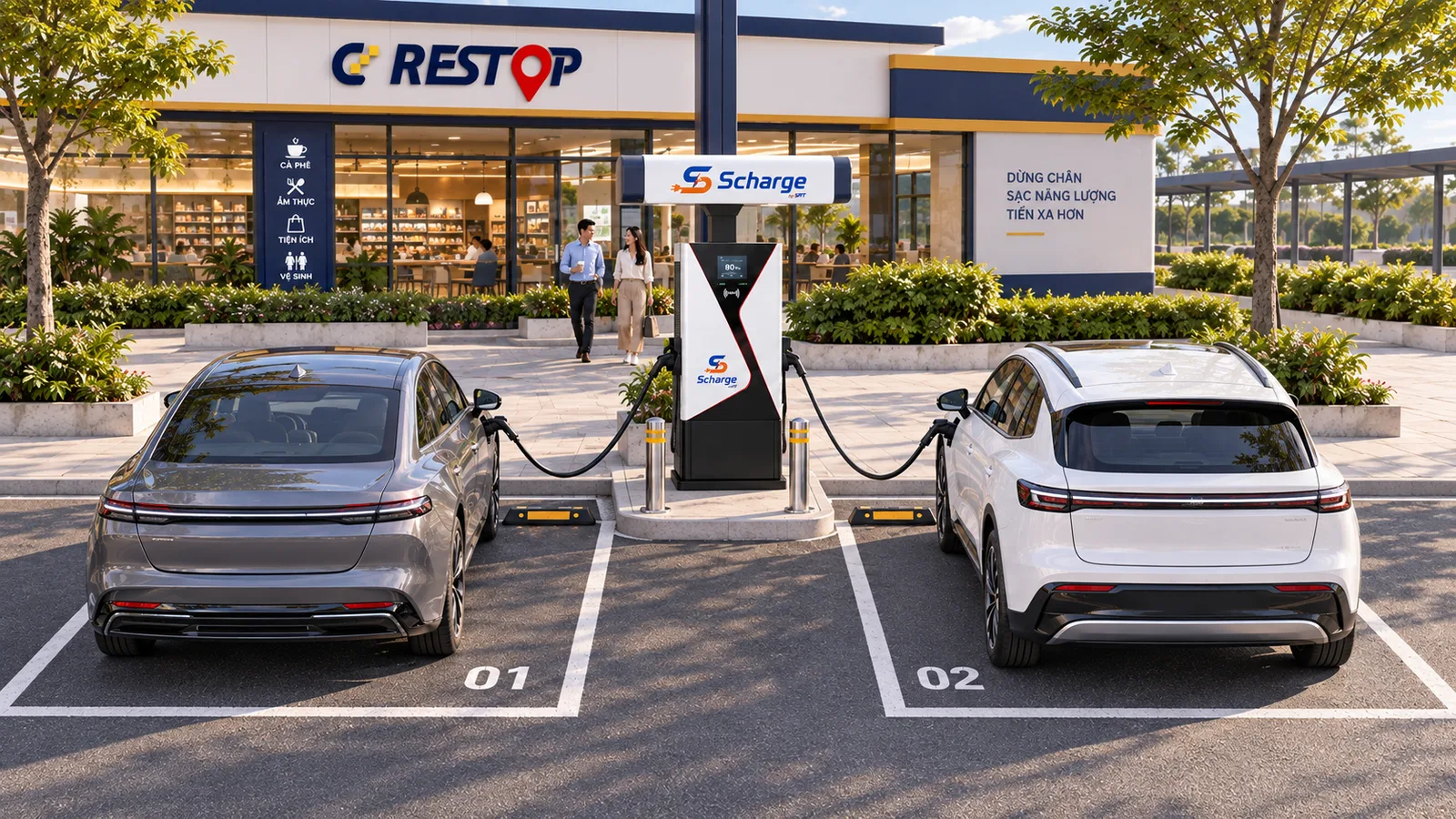
The Scharge charging island sits near the gate, under a solar canopy that shelters from rain and sun while generating power. Cars and trucks use two separate lanes. On-site solar power is combined with storage and the national grid. For us, what decides the charging experience is not the charger. What decides it is whether, while waiting, people have somewhere to eat, somewhere to rest, a clean toilet and something to do. That is how we keep users staying with electric vehicles.
Digital citizens, community and families
The digital citizen station is a mandatory module at all four tiers. A driver waiting for a charge can complete public administrative procedures at the counter. The digital finance kiosk allows safe transactions right at the site. A policy notice board and community space make each site a welfare institution for its locality, not just a charging station with a few more seats. For a family stopping for thirty minutes, standard toilets with no fee are the commitment at every tier, including affiliate points. The waiting area has wifi, greenery, safe lighting, accessible entry for people with disabilities and signage visible from a distance so that nobody has to guess.
Our direction and an invitation
We are aiming for a network covering 34 provinces and cities, with 500 rest stops and 14,000 satellite charging points. This is an indicative target, not the current state. We will publish the roadmap and the figures for each phase as progress is made.
Replication needs sites, and the sites are in your hands. We invite site owners at urban gateways, port clusters, industrial parks and in wards and communes to sit down with us. A shop, a car park, a petrol station, a community hall or a local market can all become a Tier C affiliate point. We survey, score and rank before drawing, so that you know in advance what your site will have.
Four hours at the wheel, then where do you stop? We want the answer to be simple: stop at a standardised rest stop, in any province.
Site partnership enquiries: hotline 0981 107 900 · email hi@cdrestop.com.
See how charging zones are laid out across the four rest stop tiers on the Scharge stations page.