
📋 Article outline
The opening question in almost every conversation about EV charging infrastructure is nearly always the same: which charger to buy, how many kW, which connectors. Those are the easiest questions to answer — and the ones that least determine success or failure. A fast charger can be specified and installed within a few weeks. But a power supply strong enough for that charger to deliver its rated output, stable during exactly the hours customers need it, and with headroom for the equipment's ten-year life cycle — that is an entirely different problem.
This is why CD Restop chose an alliance approach rather than building the whole charging infrastructure chain itself. Taken apart to the foundations, this is a problem spanning four different industries: power distribution, renewable energy, telecommunications and operating technology, and service real estate development. Bringing those four capabilities together through clearly divided roles is far faster and far less wasteful of capital than one company standing up all four on its own.
The real problem is not the charger
A concrete case: a highway-side site wants to install four 160 kW DC cabinet fast chargers for passenger cars and long-distance coaches. On paper the arithmetic is tidy — buy the chargers, connect them, launch the app, sell electricity. On the ground, it breaks at step two.
Four 160 kW DC chargers running simultaneously create a very large and very steep instantaneous load — power jumps from near zero to peak within seconds as vehicles plug in. Connect that to an existing supply sized for ordinary service loads and the outcome goes one of two ways: the software is forced to derate each charger to stay under the limit — customers wait far longer than the advertised specifications suggest; or the site's internal network suffers voltage sag, affecting the other loads on that same site.
Put differently, "160 kW" is only the maximum capability of the equipment. The power a customer actually receives is a function of the incoming supply, cable cross-section, distribution board configuration, the capacity registered with the utility, and the ability to manage load dynamically across chargers. The charger is the visible part; what decides the experience lies underground and inside the switchboard. Add one further layer — time of day: fast-charging demand concentrates into a few windows, usually the same hours when the grid is most stressed.
Four investment components — leave one out and the project stalls
The CD Restop – Scharge – SPT alliance has settled on an investment model of four technical components, designed together from the site survey stage onward.
1. Low-voltage power distribution — the foundation of the network
Transformer station, distribution boards, supply cabling and dedicated metering for charging operations, plus capacity registration with the utility sized to the charger cluster, with headroom for EV growth over the next 5–10 years. Upgrading a transformer after a site is already operating always costs far more than sizing generously from the outset. This is the component most often trimmed to save upfront capital, and the most expensive one to trim wrongly.
2. Rooftop solar — on-site generation
Rooftop systems over the parking area, canopies and service buildings, on a self-generation, self-consumption model. Solar cannot replace the grid for fast charging, because its generation curve does not coincide with the charging demand curve. Its value lies elsewhere: less grid electricity purchased during daylight hours, less pressure on the registered capacity limit, and a demonstrable clean-energy base for the emissions reporting of corporate customers.
3. BESS — the load-balancing piece
The component most often skipped, and the one that changes the nature of the problem the most. Battery storage takes in solar during the day and off-peak grid electricity, then discharges to support the fast chargers at peak hours. The result: the station's peak demand drawn from the grid is flattened substantially — serving more vehicles at once without a matching upgrade of grid infrastructure, and over the long term opening the way to microgrids at larger complexes.
4. Smart chargers — the part customers see
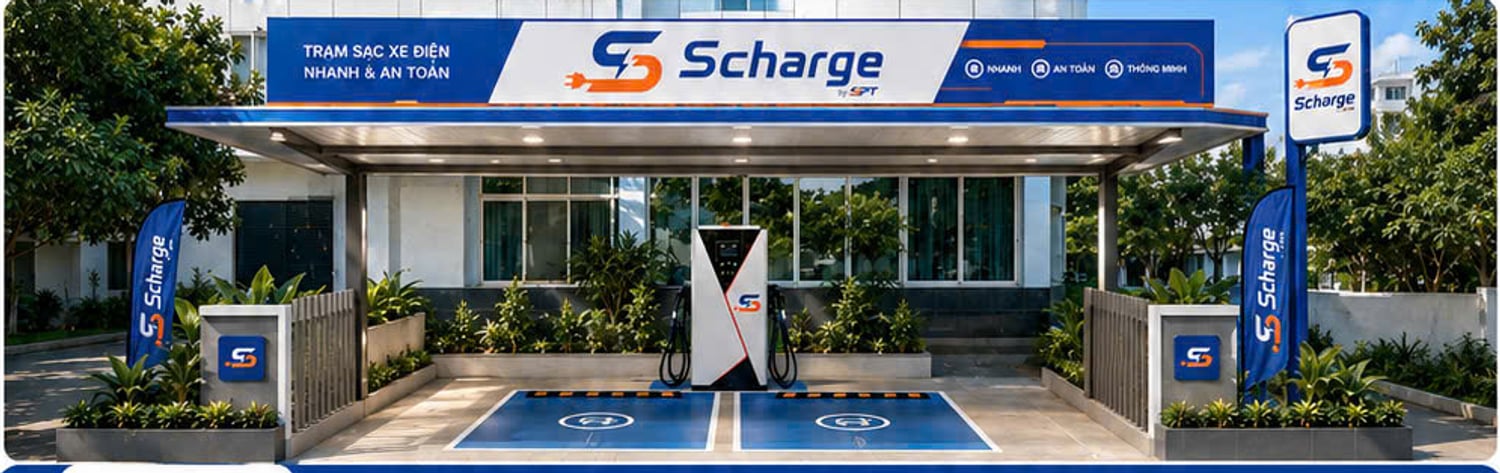
The Scharge range spans AC 7/14 kW for overnight charging through DC 40/80/160 kW and DC 200–400 kW for cars, buses and trucks. A 1000V platform with a 200–1000V DC output range serves both lower-voltage vehicles and new-generation 800V architectures; DC connectors cover CCS1, CCS2, GB/T and CHAdeMO, and AC covers Type 1 and Type 2 — the precondition for a public station that turns no vehicle away. Maximum output current is 250A on units up to 160 kW and 300A across the 200–400 kW range; efficiency of 95.5% and 94%; IP54; operation from −25℃ to 50℃; Ethernet/4G/3G connectivity with OTA updates via an IoT platform; payment by QR code, card, VIN recognition or app; Class 1 accuracy metering for transparent energy reconciliation.
The four components constrain one another: BESS configuration depends on the capacity of the charger cluster and the load profile; solar scale depends on available roof area; the registered capacity limit depends on all three of the others. Sequential design — buy the chargers first, work out the electricity later — almost always ends in piecemeal investment and rework.
Dividing the roles: who does what, and why
When a problem spans four industries, the cheapest way to solve it is not for one company to learn all four, but for four mature capabilities to stand inside a single structure of responsibility.
- SPT (Saigon Postel) — owner of the Scharge brand, supplying the chargers, the app platform and the operating software; it also brings telecommunications transmission infrastructure into the alliance for station connectivity — the path travelled by every charging session start, payment, monitoring event and software update.
- CD Restop — distributor and infrastructure developer: site survey, construction investment, installation, integration of stations into the community rest-stop chain, and 24/7 operation — work that requires understanding the site, long-haul traffic flows and local grid-connection procedures.
- Coro Energy PLC — clean energy infrastructure investor, participating in the solar and BESS components; bringing a specialist investor into precisely the two most capital-intensive components separates energy risk from station operating risk.
- DTH Holdings — energy and technology investor, participating in the electrical infrastructure and the EMS/OMS management platform: EMS coordinates energy flows between the grid, solar, battery storage and the chargers; OMS manages network operations. Without this layer, the four physical components remain four separate systems.
Alongside them, accompanying partners: Giang Sơn Việt (communications and events), DBMC (out-of-home advertising), Nông Lâm Phú Châu (design and construction, Đồng Nai), Chao Holding (F&B and hospitality).
A single charging station that works is an equipment problem. A charging network that works at scale is an organisational problem — and organisational problems are solved by dividing the roles, not by unilateral effort.
Why the rest stop is a natural anchor
The biggest challenge facing a standalone charging station is not technical but idle time: a charger creates value only while a vehicle is plugged in, and for most of the remaining hours it is an asset sitting still. The problem, then, is to place chargers where traffic already exists naturally.
A rest stop solves this almost self-evidently. A long-distance trip already has to stop for 30–45 minutes to rest, eat and use the facilities — precisely the length of a fast-charging session. Charging asks the driver to change no habit and to spend no extra time; it slots into a pause that already exists.
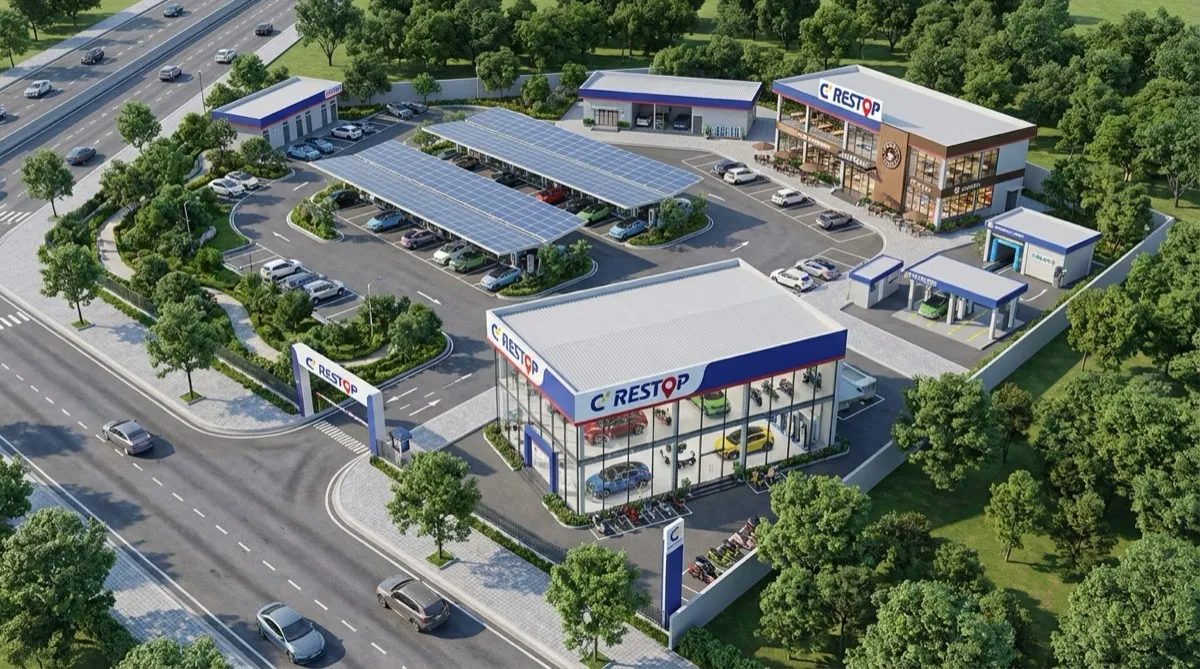
CD Restop's rest-stop model carries four layers of value stacked on one another: amenities for drivers and passengers; clean energy infrastructure; local commerce and culture; operational data. The charging station plays a dual role — both an essential service and the anchor that holds traffic for the other layers. It is also one of the rare settings that meets all three prerequisites of the four components: space for switchgear and storage systems, roof area for solar, and an economic rationale for investing in a dedicated transformer station.
From cooperative intent to formal commitment
The network is at an early stage, with several stations operating in Ho Chi Minh City. The honest way to speak about scale is to speak about the roadmap, not to speak as though the network were already built out.
The signing ceremony on 09/09/2026 marks the alliance's transition: from cooperative intent to formal commitment between CD Restop (investor and developer), SPT (charging technology and station operations), Coro Energy PLC and DTH Holdings (investors in energy infrastructure and the management platform). The practical meaning: the capital-intensive components — low-voltage distribution, solar, storage — have committed resources and clearly accountable owners. From that base, expansion proceeds under the agreements signed, prioritising locations that satisfy the conditions of traffic, site area and grid-connection feasibility; the sequence is decided by field surveys, not by unit-count targets.
"Genuinely green charging": green from the source
An electric vehicle is only as clean as the electricity put into it. If all of a station's electricity is drawn from the grid at peak hours, emissions simply move from the tailpipe to the power plant rather than disappearing — that is the gap between "green vehicles" and "green charging" that the market often overlooks.
The four-component structure narrows that gap through mechanism rather than slogan: on-site solar creates a directly clean source; BESS shifts consumption away from the hours when the system has to call on its most expensive generation; EMS coordinates automatically on data rather than on operator intuition. For companies required to report supply-chain emissions, that is the difference between a figure that can be evidenced and a claim that cannot be verified.
Three ways to join the network
- Buy and self-operate — the partner buys genuine chargers and installs them at its own site; CD Restop handles installation, app activation and warranty; the partner keeps all charging revenue.
- Joint investment and operation — the partner contributes the site and the transformer station; CD Restop invests in the chargers, construction, software, operations and sales; the two sides share actual monthly revenue as agreed.
- Corporate charging stations — turnkey design, installation and operation of a dedicated station for the EV fleets of transport, delivery and ride-hailing companies under a service contract. This is where the four-component problem shows itself most clearly: a fleet charging together by shift produces a very steep load profile.
Commercial terms are set by the price list issued by SPT and by the findings of each site survey — there is no default configuration, because no two sites are alike.
Contact
Three steps: send your requirements to hi@cdrestop.com; CD Restop carries out a field survey and proposes a solution matched to the actual power supply, site and traffic conditions; the two sides agree on a model, sign and deploy. The survey step is where every assumption made on paper is tested against field data.
Learn more about the Scharge charging ecosystem at the Scharge brand site.