
📋 Article outline
Foreword: A complete institutional framework from the Party to the National Assembly
Within just the first four months of 2026, Vietnam issued two strategic documents of exceptional importance to the cultural sector. On January 7, 2026, on behalf of the Politburo, General Secretary To Lam signed Resolution No. 80-NQ/TW on the development of Vietnamese culture — a document laying the ideological foundation, guiding viewpoints, and strategic objectives for the entire national cultural cause in the new era. On April 24, 2026, the 16th National Assembly at its First Session officially passed Resolution No. 28/2026/QH16 on the development of Vietnamese culture, effective from July 1, 2026 — the legal document that institutionalizes the Politburo's policies into a system of concrete and feasible mechanisms and policies.
This is an exemplary legislative process: from the Party's strategic orientation (Resolution 80) to the State's concrete legal mechanism (Resolution 28), forming a complete, synchronized, and highly binding institutional framework. For the first time in Vietnam's legislative history, culture is affirmed not only as a spiritual foundation, but also as a strategic economic pillar, an industry creating added value and contributing directly to national GDP.
This analysis will clarify: (1) the strategic vision of Resolution 80-NQ/TW, (2) the concrete incentive mechanisms of Resolution 28/2026/QH16, (3) the investment opportunities posed for the private sector, and (4) the pioneering spirit needed by Vietnamese cultural industry investment enterprises.
I. Resolution 80-NQ/TW — The Politburo's strategic declaration
1. Positioning culture in the new era
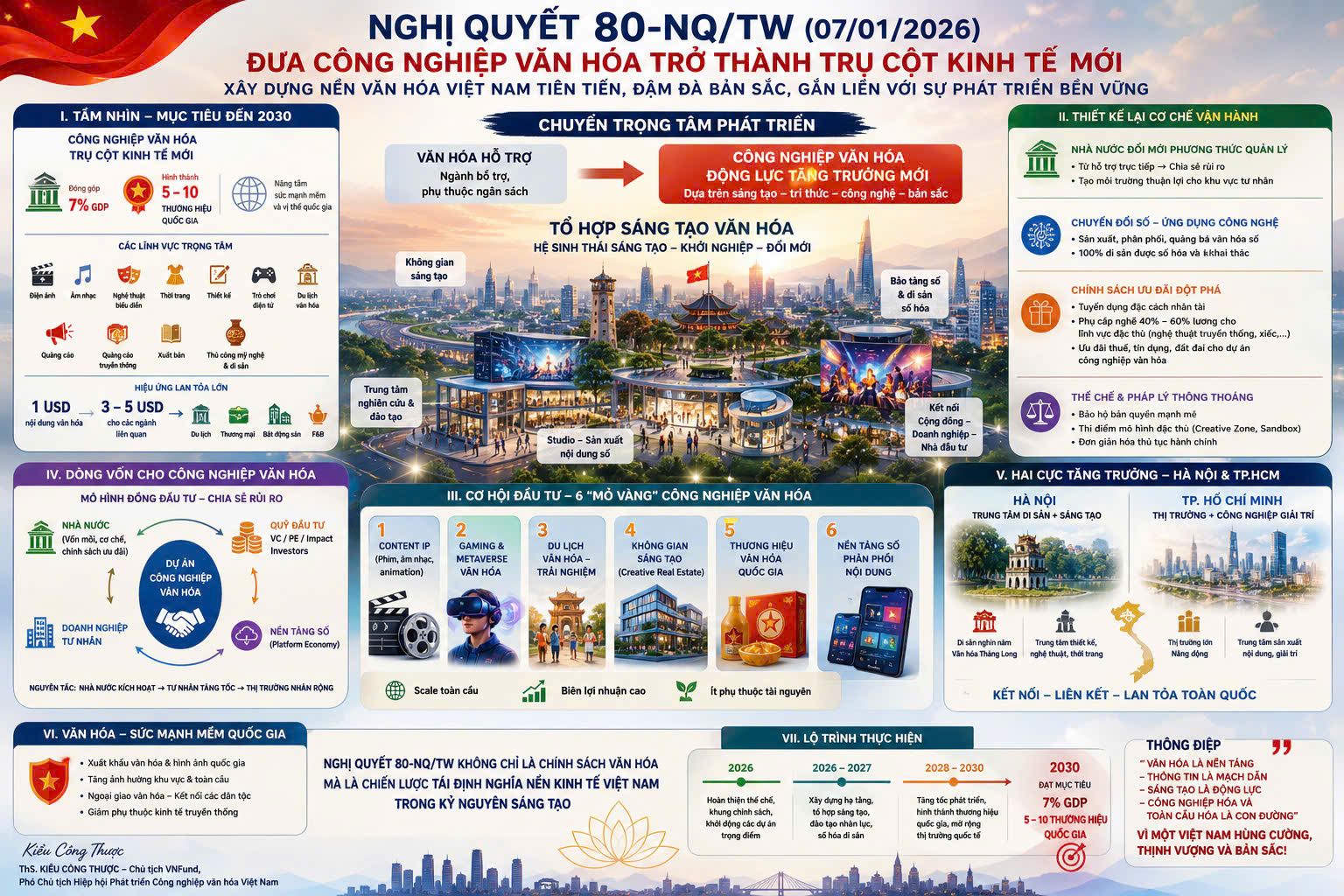
Resolution 80-NQ/TW affirms a turning-point guiding viewpoint: "Developing culture and people is the foundation, an important endogenous resource, a great driving force, a pillar, and a regulating system for the rapid and sustainable development of the country." Culture is placed on par with politics, economy, and society, tied to building a defensive posture for cultural security, human security, and digital cultural sovereignty.
Notably, Resolution 80 for the first time establishes a new mindset on cultural investment: "Investing in culture is investing in the sustainable development of the country, in the future of the nation." State resources play the leading role, social resources and the private sector are an important driving force; institutions play the key role — especially breakthrough mechanisms and policies to mobilize and effectively use investment resources for culture, and to attract and value talent.
2. Quantitative targets to 2030 and vision to 2045
Resolution 80 sets out a series of concrete, measurable indicators:
By 2030:
- Allocate at least 2% of total annual state budget expenditure to culture, increasing gradually according to practical needs
- Cultural industries contribute 7% of GDP
- Form 5 to 10 national brands in the cultural industry in the fields of cinema, performing arts, cultural tourism, design, and fashion
- Digitize 100% of cultural heritage ranked at national and special national levels by 2026
- Successfully build 5 brands of international art festivals and cultural festivals on cinema, music, and fine arts
- Establish an additional 1–3 Vietnamese cultural centers abroad
- Strive for an additional 5 cultural heritages recognized and inscribed by UNESCO
- 100% of two-tier local governments have cultural institutions meeting creative and enjoyment needs
Vision to 2045:
- Cultural industry and creative economy contribute 9% of GDP
- 10 brands of art festivals and cultural festivals of international stature
- An additional 8–10 UNESCO heritages
- Strive to be in the Top 3 ASEAN region and Top 30 worldwide in the Soft Power Index and export value of cultural industry products
These are ambitious but well-founded goals: with Vietnam's GDP continuing to grow, the 7% GDP threshold by 2030 is equivalent to a cultural industry market scale of tens of billions of USD — on par with the leading cultural industries of Southeast Asia.
3. Three priority breakthrough areas
Resolution 80 identifies a priority financial mechanism to implement three breakthrough areas:
First, training and remuneration of talent in the field of culture and arts.
Second, applying science, technology, and digital transformation in the cultural field.
Third, commissioning the creation of cultural works, literary and artistic works of high value in ideology, content, and artistry, worthy of Vietnamese culture in the new era.
At the same time, the Resolution requires combating the tendency toward "commercialization", not one-sidedly emphasizing economic benefits in cultural activities — this is an important signal showing that the policy not only encourages investment but also requires investors to have social responsibility and cultural business ethics.
4. Breakthrough policy on public-private cooperation
Resolution 80 opens an unprecedented institutional space for the private sector:
- Public leadership – private governance model
- Public investment – private management
- Private investment – public use for certain cultural and sports institutions
- Encourage cultural and arts patronage models on the basis of voluntary, non-profit contributions
- Build Cultural and Arts Funds under a public-private model
- Outstanding preferential policies on land, exemption and reduction of corporate income tax for creative startup enterprises in the cultural field, prioritizing the cultural industry and entertainment industry
This is the direct premise for the system of concrete incentives institutionalized by the National Assembly in Resolution 28/2026/QH16.
II. Resolution 28/2026/QH16 — Mechanizing the spirit of Resolution 80 into law
Resolution 28/2026/QH16 is not an independent document, but the full and synchronized institutionalization of the orientations of Resolution 80-NQ/TW into legally binding norms. In Part III, Section 3 of Resolution 80, the Politburo assigned the Government Party Committee to coordinate with the National Assembly Party Committee to "issue a National Assembly Resolution on the development of Vietnamese culture at the 2nd Session of the 16th National Assembly with concrete, feasible, and effective incentive mechanisms and policies." Resolution 28 is precisely the accurate implementation of this directive.
Below are the key policy pillars of Resolution 28 that investors need to understand clearly.
1. Vietnam Culture Day and the 2% financial commitment
Article 2 of Resolution 28 stipulates that November 24 annually is Vietnam Culture Day, on which workers are entitled to a day off with full pay. Article 3 legalizes the financial commitment: The State guarantees annual spending on culture of at least 2% of total state budget expenditure, increasing gradually according to development needs.
With Vietnam's total state budget expenditure currently at over 2 quadrillion VND per year and continuing to rise, the 2% commitment is equivalent to over 40,000 billion VND per year dedicated to culture. This is a market scale large enough to form a real cultural industry, creating stable demand for investment enterprises.
2. Two new investment infrastructure models
Article 4 establishes two physical infrastructure models unprecedented in Vietnam's legal system:
Cultural creative industry clusters and zones — areas with defined geographic boundaries, concentrating organizations and enterprises operating in the cultural industry, invested and built to link creative spaces, R&D, experimentation, production, distribution, and commercialization of cultural products. The goal is to form a synchronized, modern cultural-entertainment industry ecosystem based on a high-tech platform.
Cultural creative complexes — complexes of works, spaces, and technical infrastructure serving leasing, exploitation, and use for the development of the cultural industry combined with commerce and services. Particularly important: the Resolution allows the conversion of the function of old factories and works into cultural creative complexes — a mechanism unlocking thousands of hectares of obsolete industrial land in major cities.
Organizations and individuals investing in these two models enjoy support policies for access to land and production-business premises under Article 7 of Resolution 198/2025/QH15 on the special mechanism for private economic development — creating a synergy effect between the two major policies.
3. The "three-layer" tax incentive package for the cultural industry
Clause 4, Article 4 of Resolution 28 stipulates tax incentives for organizations and individuals investing in digital infrastructure, high-tech solutions for culture, and key cultural industries: cultural tourism, cinema, performing arts, fine arts, online video games with educational, propaganda, and promotional content of Vietnamese cultural-historical values.
Layer 1 – Corporate income tax: Tax exemption for 2 years and a 50% reduction of payable tax for the following 4 years on income from the cultural activities of enterprises.
Layer 2 – Tax on capital transactions: Exemption of personal income tax and corporate income tax on income from the transfer of shares, capital contributions, capital contribution rights, share purchase rights, and capital contribution purchase rights in cultural enterprises. This is an extremely strong incentive — equivalent to the policy for high-tech innovation startups — allowing venture capital funds and angel investors to exit tax-free.
Layer 3 – Personal income tax of talents: Tax exemption for 2 years and a 50% reduction in the following 4 years on income from salaries and wages of experts and scientists received from cultural activities. This is an extremely effective tool for attracting international talent.
Addition – 5% value-added tax: Article 5 reduces VAT from 10% to 5% for film production, distribution, and dissemination activities; exhibitions; professional sports; and performing arts.
4. Land and public asset mechanisms
Clause 4, Article 5 stipulates that provincial People's Committees are responsible for:
- Allocating land funds for cultural and sports works and public art display spaces
- Prioritizing the allocation of surplus public headquarters to attract cultural investment projects; leasing surplus public headquarters and state-owned works for cultural activities
- Exempting and reducing land rent and public real estate rent for publishers and documentary and scientific film production facilities
The surplus public headquarters mechanism is particularly important in the context of administrative unit mergers — thousands of facilities will become an abundant asset fund for cultural creative complexes, performance spaces, and private museums.
5. Repatriation of antiquities — A breakthrough mechanism
Clause 2, Article 5 establishes a breakthrough mechanism for heritage repatriation:
- 100% exemption of import tax and customs fees for peak artworks and rare antiquities
- Not subject to value-added tax
- Applicable also to cases of purchase, auction, bringing to Vietnam not for profit purposes for display, or donation, transfer of ownership to the State
This is a historic opportunity for private organizations and collectors to participate in the national cause of repatriating antiquities — a mission of profound cultural and spiritual significance.
6. Heritage cities — A pilot model to 2035
Clause 3, Article 5 allows local governments to pilot the heritage city model according to criteria stipulated by the Government, with the authority to decide on preferential mechanisms regarding land, fees, and charges in the area. The pilot period is a maximum until the end of 2035 — nearly a decade of stable operation for strategic cultural-heritage PPP projects.
7. Special talent remuneration policy
Article 7 designs a specialized remuneration system:
- Recruitment without examination for excellent graduates, talented athletes and artists who have won medals at national, regional, and international levels
- Professional preferential allowance of 40% to 60% of salary for traditional, classical performing arts and circus; border, island, and ethnic minority areas; 20% to 30% for other cultural fields
- Subsidy regime of 5% to 30% of the basic salary level for each rehearsal/performance session
- Support for retraining costs for traditional arts officials at the end of their career age; training of high-quality human resources for the cultural industry and digital transformation
8. Digital transformation and new digital business models
Article 10 lays the foundation for cultural digital transformation:
- Prioritizing investment in the national cultural database, digital cultural infrastructure, and shared digital platforms
- Ensuring funding for digitizing heritage at national and special national levels
- Piloting new cultural business models: open museums, mobile theaters, digital libraries — maximum 5 years
- Forming cultural innovation centers and digital content creation centers
This is a complete legal framework for Web3 projects, blockchain, cultural NFTs, AI Vietnamese content creation, virtual museums, and new-generation creative economy models.
9. Cultural and Arts Fund under the Venture Capital model
Article 11 is one of the most breakthrough points. For the first time, Vietnam pilots a Cultural and Arts Fund under a public-private cooperation model, operating like a venture capital fund, on market principles, accepting the possibility of risk:
- The central fund is established by the Prime Minister; local funds are established by the Chairman of the provincial People's Committee
- Objective: to finance and invest in creative startup enterprises in culture and arts; programs and projects with breakthrough creativity, market potential, and social spread
- The pilot period is a maximum until the end of 2035
This model places Vietnamese culture on the same policy trajectory as Israel, South Korea, and the United Kingdom — countries that have used cultural venture funds as a driving force for creative industries worth hundreds of billions of USD.
10. Principle of priority application of more favorable provisions
Clause 3, Article 13 establishes an extremely investor-friendly principle: "In case other documents stipulate incentive mechanisms and policies more favorable than the provisions of this Resolution, the beneficiary is entitled to apply that mechanism and policy." This is an important legal commitment, ensuring that investors always enjoy the best terms among legal documents.
III. Eight key cultural industry sectors — The investment opportunity map
Resolution 80 and Resolution 28 jointly identify key cultural industry sectors that need focused development:
1. Cinema — film production, distribution, and dissemination; 5% VAT incentive; tax refund policy for international filming services in Vietnam.
2. Performing arts — traditional and contemporary, from cai luong, tuong, cheo, circus to musicals and multimedia performances.
3. Cultural tourism — connecting with UNESCO heritage, heritage cities, craft villages, and traditional festivals.
4. Fine arts — exhibitions, artwork trading floors, public display spaces.
5. Design and fashion — brands bearing Vietnamese cultural identity competing globally.
6. Traditional crafts — craft villages, OCOP products, combining heritage with modern commercialization.
7. Video games — with educational content, promoting Vietnamese cultural-historical values.
8. Cuisine and software/digital content — Vietnamese restaurant chains abroad, digital content, high-tech solutions for culture.
Each of these sectors can become a billion-dollar industry if invested correctly in the coming decade.
IV. The pioneering spirit: The role of cultural industry investment enterprises
Resolution 80-NQ/TW affirms a turning-point viewpoint: "Enterprises, especially enterprises in the cultural industry, creative industry, and entertainment, are the key driving force promoting cultural innovation." This is official recognition at the highest level that the enterprise sector — not just the state sector or public art troupes — is the force that creates a true cultural industry.
In that picture, some Vietnamese enterprises have proactively anticipated the policy. Linh Nam Cosmos — the cultural industry investment unit of Linh Nam Group — is one of the pioneering examples, with an orientation to create an investment ecosystem on three pillars: Heritage Space – Heritage People – Heritage Capital. This is also a model that many other enterprises can reference to position their investment strategy in the golden period of 2026–2035.
The pioneering spirit needed in Vietnamese cultural enterprises at this stage is not only the speed of investment decision-making, but also:
A harmonious combination of economic benefit and social responsibility — in line with the spirit of Resolution 80 requiring the overcoming of the tendency to "commercialize" culture.
The ability to integrate technology into heritage — turning traditional cultural resources into digital products, digital experiences, and digital business models with international competitiveness.
Long-term vision — investing in culture not for quick profit, but to build sustainable cultural assets for future generations, while creating a stable revenue stream over a lifecycle of 10–30 years.
Responsibility to national heritage — especially in the fields of preservation, restoration, repatriation of antiquities, and protection of the languages and traditional arts of ethnic minorities.
V. Conclusion: The golden moment of a decade
When the Politburo's Resolution 80-NQ/TW and the National Assembly's Resolution 28/2026/QH16 both take effect, Vietnam has officially entered the most favorable policy cycle ever for the cultural industry:
- The cycle lasts until 2035 with pilot mechanisms
- Vision 2045 with the goal of the cultural industry contributing 9% of GDP
- A tax incentive package of up to 6 years for each investment project
- A budget commitment of a minimum of 2% of public GDP each year
- A cultural venture capital fund under the PPP model
- Transparent and supportive land and public asset mechanisms
- Heritage city models and cultural creative complexes
- A legal framework for repatriating antiquities and national heritage
This is the moment for domestic and foreign investors, venture capital funds, heritage organizations, technology enterprises, artisans, and content creators — to enter a new playing field together: the playing field of Vietnam's cultural industry in the 21st century.
The Government has handed over the institutional key. The Politburo has set strategic expectations. The National Assembly has issued concrete mechanisms. What remains — opening that door and stepping in — is the responsibility and opportunity of the enterprise sector and the whole society.
Vietnamese culture is ready for the new era. The only question is: who will be the pioneers writing that story?
Ho Chi Minh City, May 2026
Nguyen Ngoc Hai