
📋 Article outline
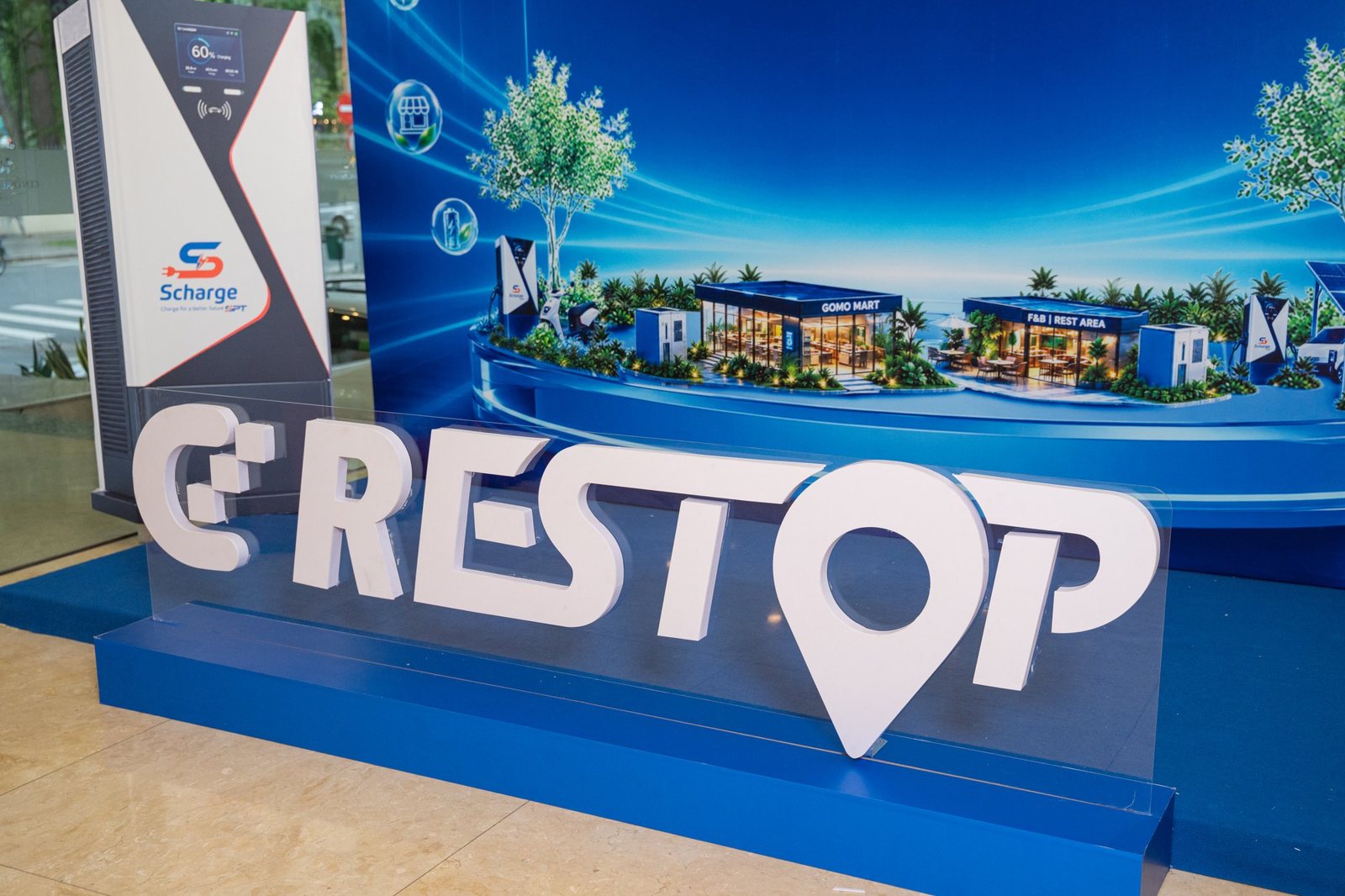
On the afternoon of 09/09/2026, in the lobby of Central Palace (Kỳ Hòa Bến Thành Hotel), a sample Scharge charger stood right beside the photo backdrop. Guests who arrived early took pictures with it before entering the signing room. The charger was for display only and did not charge vehicles on site. But it was the only thing at the ceremony that drivers will later touch with their own hands.
So we want to write a separate article about it. Not about power ratings; that is already covered in our guide to reading the power table. This article is about standards: what language the Scharge charger uses to talk to the car, and what language it uses to talk to the management system.
One sentence that appears in both documents
Of the four documents signed that day, two speak directly about charging equipment. The first is the Strategic Cooperation Agreement for the Scharge Project between SPT Group (Saigon Postel), us, DTH Holdings and Coro Energy. The second is the Memorandum of Understanding on chargers and low-voltage infrastructure between SPT Group and XECO, which we witnessed.
Both record the same content in the clause on technical standards: charging station equipment uses the international connector standard (CCS2) and an open protocol (OCPP), serves every car brand, posts prices publicly, and meets Vietnam's technical regulations and its electrical safety and fire prevention and fighting requirements.
That sentence has four parts. Each part is a promise to the driver. We take them one by one.
What CCS2 is and why CCS2 was chosen
CCS2 stands for Combined Charging System, type 2. It is a connector standard that uses a single port on the car for both regular AC charging and DC fast charging. The upper part of the port is the familiar Type 2 connector for AC charging. The lower part adds two large pins for direct current.
This standard is used by most electric cars sold in Vietnam. Choosing CCS2 as the connector standard means that an ordinary electric car driver who pulls into a rest stop can plug in without carrying an adapter.
The Scharge charger range published on the Scharge introduction page also includes other connectors: CCS1, GB/T and CHAdeMO for DC charging, Type 1 and Type 2 for AC charging. The voltage platform is 200–1000 V DC, so it can serve both 400 V and 800 V vehicle architectures.
What OCPP is and why the word “open” matters
CCS2 is the language between the charger and the car. OCPP is the language between the charger and the management system behind it.
OCPP stands for Open Charge Point Protocol, an open protocol maintained by the Open Charge Alliance. Through this protocol, the charger tells the centre whether it is free or busy, receives commands to start and end a charging session, sends the amount of electricity delivered, reports faults and receives remote software updates.
The word “open” means that chargers from many different manufacturers can connect to the same platform. For the Scharge Project, that platform is the Scharge Platform of SPT Group: the user app, payment and charging-session management. The Memorandum of Understanding between SPT Group and XECO states clearly that equipment must be compatible with the Scharge Platform through an open protocol.
What does the driver get from this? One app, one account, one way to pay at every site, no matter who supplied the charger at that site. What does the site owner get? No lock-in to one equipment brand. In principle, any charger that meets the standard and speaks the open protocol can connect to the platform. We covered the platform in detail in the article it is software that runs the charging station.
“Serves every car brand”: stating the scope clearly
We want to state the scope clearly, because this is where things are easily overread.
“Serves every car brand” in the documents is a principle: the Scharge charger is not reserved for the vehicles of any single brand. Any vehicle whose charging port follows a standard the charger supports can charge.
That principle does not mean every site has every type of connector. The charger and connector configuration at each site is decided after a survey, according to the vehicle types that actually travel that route, and is recorded in the detailed agreements for each site cluster. Drivers should check a site's connector information in the app before they arrive.
Publicly posted prices
The third part is short, but we take it seriously. Drivers must know the price before they plug in, not after they receive the invoice.
The charging tariff is issued by SPT Group on the Scharge Platform. This article gives no figures, because prices may change over time and from site to site. Publicly posted means the price must be clearly shown where the driver can see it before starting a charging session.
Electrical safety and fire prevention and fighting
The last part is a condition for being installed, not a bonus. A DC fast charger works with voltages up to 1000 V and currents up to 250 A per gun. The published specifications of the Scharge fast charger line include IP54 protection, class 1 metering accuracy and these layers of protection: overvoltage, undervoltage, leakage protection, lightning protection, overtemperature, overcurrent, overcharge, automatic cut-off when full, and earthing monitoring.
Our part lies in the site: safety distances, exits, firefighting equipment, staff on duty. A compliant charger placed on a carelessly run site is still an unsafe charging point.
Frequently asked questions about Scharge charger standards
Can my electric vehicle charge at a Scharge charger?
If the vehicle has a charging port that follows a standard supported by the charger at that site, it can charge, regardless of brand. CCS2 is the connector standard named in the documents. Other connectors depend on the configuration of each site.
What does OCPP have to do with the driver?
The driver never sees OCPP. But thanks to it, every charger in the network shows its correct status in one app and bills in one way.
Who manufactures the Scharge charger?
SPT Group owns the Scharge brand and issues the equipment standard. Equipment suppliers are considered separately for each project, based on technical requirements, investment efficiency and commercial terms.
I want Scharge chargers at my site; where do I start?
Send your site information to hi@cdrestop.com or call 0981 107 900. The three forms of cooperation are in the article three ways into charging infrastructure.
What the driver gets
Technical standards sound dry. But for a long-distance driver, they come down to a few very concrete things. You turn into a rest stop with fifteen percent of battery left, and the charging gun fits the car's port. The screen shows the price before you press start. The app correctly shows which charger is free. And while the car charges, the driver has a place to eat, a place to wash their face, a place to lie back.
The four parts of one sentence in a document exist so that such a stop goes that smoothly.
The course of the ceremony is in the 09/09 news report. The role of each party is in the article ten parties put pen to paper.
See the charger range and technical specifications on the Scharge products page.