
📋 Article outline
The company's very name — CD Restop Social-Welfare Infrastructure Investment Corporation — is not a slogan but a blueprint. "Integrated social welfare" can sound abstract, yet at CD Restop it becomes something you can see, touch and use at every stop: a miniature social-welfare institution set beside the road.
Three overlapping layers of function
Each stop is designed on three interwoven layers: green transport infrastructure, welfare-priced services, and a community institution. Travelers pause not only to recharge their vehicles, but also to rest, eat, shop and connect.
The "5 Guarantees" standard
Whatever its size, every CD Restop point commits to five foundational values:
- Clean energy: charging points paired with on-site solar power.
- Meals and essential goods at publicly listed, welfare-level prices.
- Safe, convenient digital financial services.
- Regular community and cultural activities.
- Traveler welfare: free rest areas and restrooms, plus a policy-information corner.
Nine zones of a full-scale point
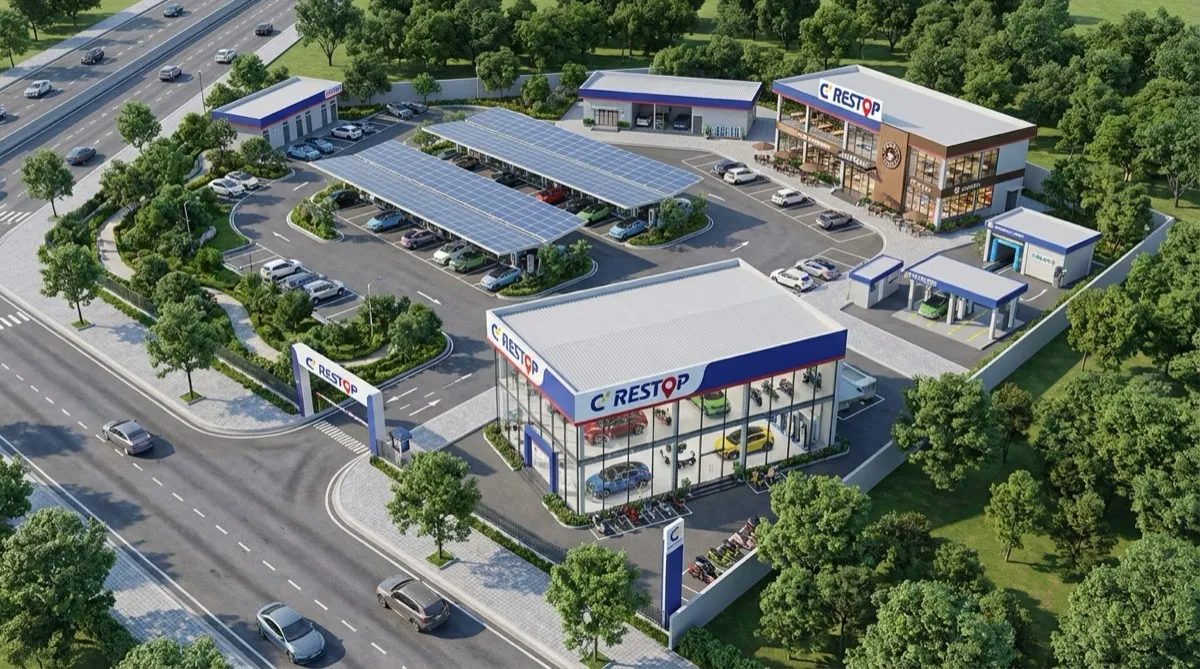
A full-scale stop is organized into nine standard zones: an identity gateway; a zoned parking area; a charging island; a food and welfare-meal block; an essentials store with a digital-finance point; free rest areas and restrooms; a community space; a technical zone; and green landscaping, with a green belt covering at least 8% of the area. The charging station serves every vehicle brand through the CCS2 standard and the open OCPP protocol, while the GOMO store prioritizes Vietnamese goods, OCOP products and cooperative-grown farm produce.
Four scales, one philosophy
To replicate flexibly, the model is standardized into four scales: Complex (3,000–5,000 m²); Class A (1,500–3,000 m², flagship points); Class B (500–1,500 m², at urban gateways); and Class C, linked to existing premises with a minimal set of components. CD Restop currently operates its first stops in Ho Chi Minh City, with plans to expand the network in the years ahead.
The company invests and takes responsibility for operations on its own, without relying on the state budget, working alongside local authorities and staying close to the goals of social welfare and green transition. Enhanced health-care packages such as blood-pressure and blood-sugar checks and insurance support are intended for rollout in the future.
Learn more about CD Restop's Social-Welfare model at cdrestop.com.