
📋 Article outline
On June 4, 2026, Deputy Prime Minister Ho Quoc Dung signed Decision 982/QD-TTg approving a program to support and develop Vietnamese digital-technology enterprises going global by 2030, with a vision to 2045. For the first time, Vietnam has set out a comprehensive system of targets for technology exports — opening significant room for innovation infrastructures such as Times Zones.
An unprecedentedly ambitious program
As global technology supply chains are being strongly restructured under the impact of artificial intelligence (AI), cloud computing, semiconductors and digital transformation, Decision 982/QD-TTg is regarded by experts as one of the largest and most ambitious programs ever for Vietnam's digital-technology sector.
What stands out is that this is the first time Vietnam has established a relatively comprehensive system of targets for technology export activities — a field seen as the true measure of the competitiveness of a knowledge economy. The overall goal is to develop a corps of Vietnamese digital-technology enterprises that master core and strategic technologies, participate deeply in the global value chain; and to form a strong, sustainable digital-enterprise ecosystem that contributes to double-digit economic growth and elevates the Make in Viet Nam national brand.
By 2030: numbers that speak
To realize that aspiration, the Government has set a series of concrete, clearly quantified targets for 2030:
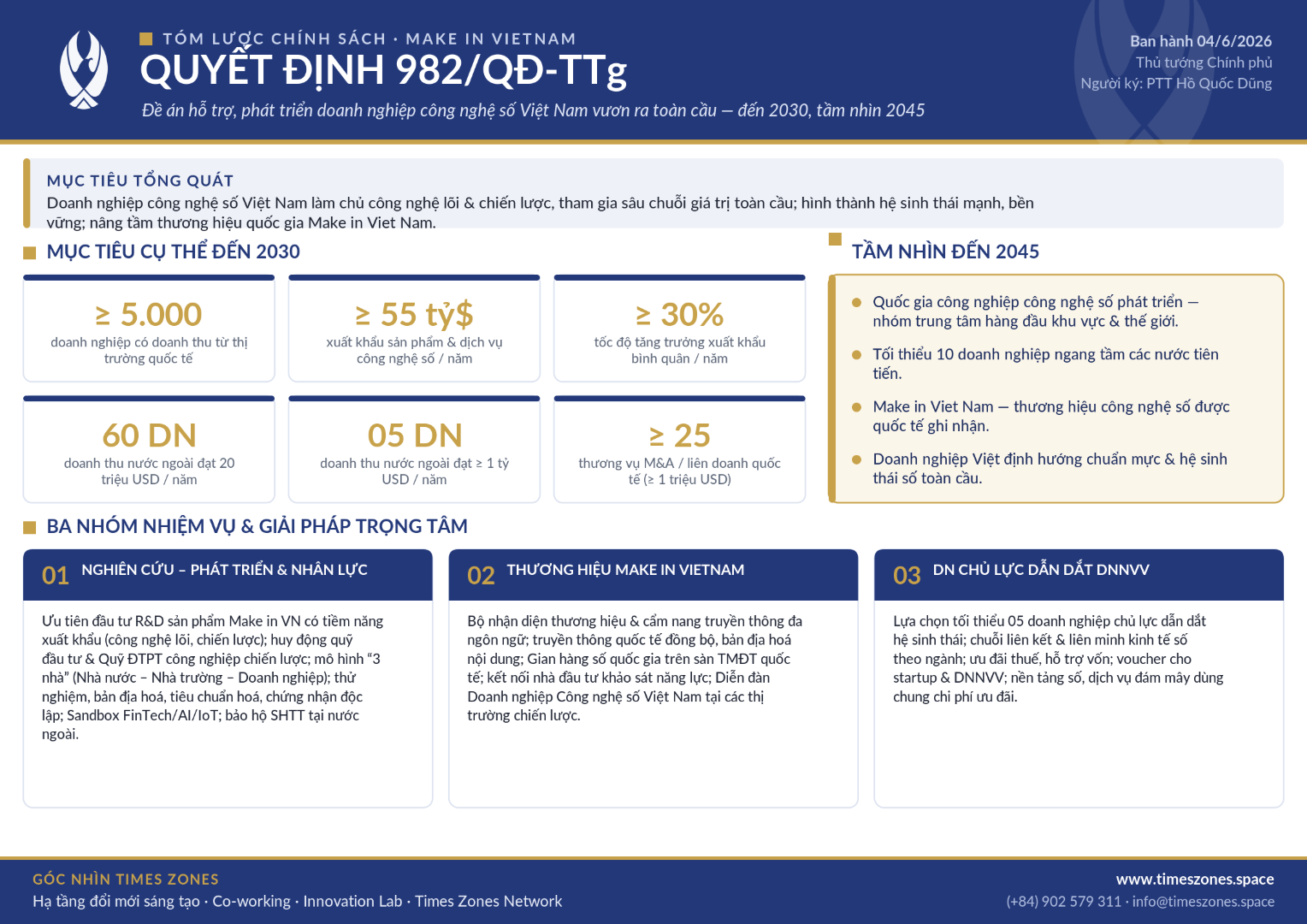
• At least 5,000 Vietnamese digital-technology enterprises earning revenue from international markets;
• Export revenue from digital products and services reaching at least USD 55 billion/year, with average growth of at least 30%/year;
• 60 enterprises achieving foreign-market revenue of USD 20 million/year;
• In particular, forming at least 5 enterprises with foreign revenue exceeding USD 1 billion/year;
• Successfully completing at least 25 merger & acquisition (M&A), joint-venture or international strategic-cooperation deals, each worth USD 1 million or more.
This tiered approach shows that the goal is not merely to increase the number of enterprises, but to build a sustainable industry structure with locomotives strong enough to lead and create ripple effects across the whole ecosystem. In fact, Vietnam already has enterprises reaching the billion-USD milestone in foreign-market revenue, showing that the program's targets stem from a practical basis.
Vision to 2045: from participant to creator
Looking further ahead, by 2045 the program aims to make Vietnam a developed digital-technology industrial nation, among the leading digital-technology industrial hubs of the region and the world; to have at least 10 digital-technology enterprises on par with advanced countries; and to make the Make in Viet Nam brand a reputable digital-technology brand recognized by the international community.
More important than the figures is a shift in mindset: Vietnamese enterprises will not only master technology and markets, but also help shape the direction of global digital-technology development, contributing to building international norms, standards and digital ecosystems — moving from the role of participant to that of creator in the world's technology value chain.
Three core solution groups
1) R&D of high-quality products, services and human resources. Prioritize investment for Make in Viet Nam R&D projects with export potential based on core and strategic technologies; mobilize domestic and foreign investment funds and the Strategic Industry Development Investment Fund; promote the triple-helix model (State – University – Enterprise); support piloting, localization, standardization and independent certification; build controlled-testing mechanisms (Sandbox) for new products such as FinTech, AI, IoT; support intellectual-property registration abroad.
2) Build and develop the Make in Viet Nam digital-technology industry brand. Create a brand identity and a multilingual communications handbook; deliver synchronized international communications with content localized per market; establish a Vietnam national digital pavilion on international e-commerce platforms; organize the Vietnam Digital Technology Enterprise Forum in strategic markets.
3) Form leading enterprises that guide small and medium enterprises (SMEs) to go global. Select at least 5 leading digital-technology enterprises to play an ecosystem-leading role; build sectoral linkage chains and digital-economy alliances; study tax incentives and capital-support mechanisms; deploy financial-support voucher policies for startups and SMEs; encourage leading enterprises to build shared digital platforms and cloud services at preferential cost.
The Times Zones perspective: innovation infrastructure walking with the program
As an innovation-infrastructure enterprise operating on three pillars — Co-working, Times Zones Innovation Lab and Times Zones Network — Times Zones sees in Decision 982 many points that directly intersect with its operating model.
The Times Zones Innovation Lab pillar — with incubation, R&D, product standardization and triple-helix cooperation — serves directly the SME group that the program wants to take global. This is where startups can access pilot programs, support vouchers and a mentor network to raise product standards to international requirements.
The Times Zones Network pillar — comprising a members portal, projects portal, finance portal and a domestic and international startup network — is precisely the channel connecting investment funds, partners, forums and cooperation/M&A deals in the very spirit of the program. Meanwhile, the Co-working system provides physical space and community for digital-technology enterprises.
With that orientation, Times Zones positions itself as a connector – incubator – promoter at the local level, ready to accompany the triple-helix, Sandbox, SME-support voucher, Forum and national digital-pavilion programs set out in Decision 982 — contributing a link to the journey of taking Vietnam's digital technology to the world.
A turning point for a knowledge economy
Decision 982/QD-TTg is not only a plan to support enterprises, but also a declaration of Vietnam's aspiration to a new position on the world technology map. With a USD 55 billion export target and the emergence of billion-USD technology groups, the program marks the economy's shift from relying on resources and labor to relying on knowledge and core technology. And on that journey, every innovation infrastructure, every incubator, every startup community can become part of a larger story.
(Sources: Government e-Portal; Government News; Nhan Dan; full text of Decision 982/QD-TTg dated June 4, 2026.)