
📋 Article outline
In most first conversations with a site owner or a transport operator, the opening questions are almost always the same: how many kW is the charger, how many connectors, how long to a full charge. Fair questions — but they describe a device. What actually decides whether a charging station is a dependable stop or a lump of steel in a parking lot sits in the layer behind it: the operating software platform.
Buying a charger is buying hardware; what turns hardware into a service is software. In the partnership between CD Restop and SPT — owner of the Scharge brand and supplier of both the chargers and the operating application platform — the hardware has a long mechanical lifecycle, while the software changes continuously with the EV market.
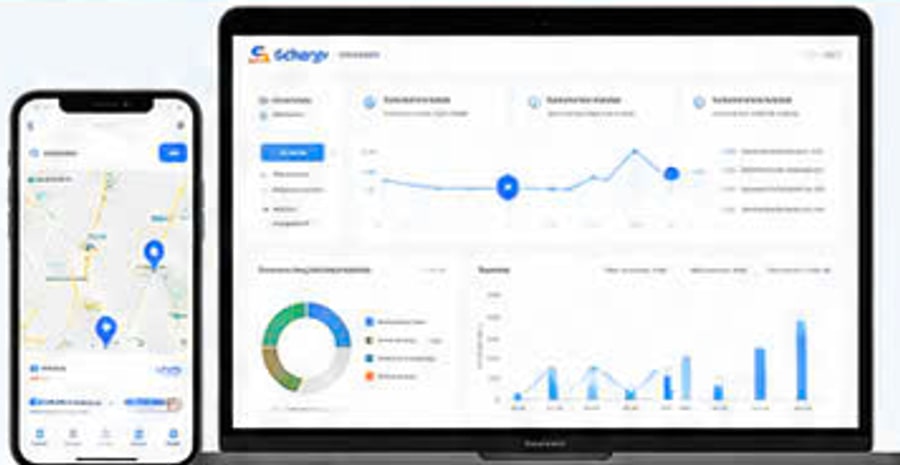
1. The lifecycle of a charging session
For the end user, charging is two actions: plug in the connector and scan a code. For the platform it is a chain of states that has to run all the way through, and every link can break.
- Identification. The charger supports QR scanning, cards, VIN recognition and the mobile app in parallel — a corporate fleet can charge without any user action at all.
- Authorization. The platform checks the account, the credit limit and the site's policy before allowing a session to start — the step that depends most on the network and, in practice, the one that fails most often.
- Handshake with the vehicle. The two sides exchange battery voltage, the maximum current the vehicle will accept and thermal status before any current flows — the 1000V platform with its 200–1000V DC output range exists precisely to cover a very wide spread of battery packs.
- Monitoring. Current, voltage and temperature are logged continuously. The platform must be able to distinguish a vehicle deliberately tapering current as the battery approaches full from a charger derating to protect itself against overheating.
- Termination. By the user, by the vehicle reporting full, by a limit being reached, or by a fault — four causes that must be logged distinctly; merging them means losing the ability to spot a recurring failure.
- Billing. kWh delivered, duration, payment method, charger, connector — at once the customer's record and the basis for revenue sharing.
A very real scenario: a truck pulls in at two in the morning and the mobile signal is patchy. A platform built on "no network, no charging" strands the driver and costs the station its reputation that same night. The correct design lets the charger ride out a temporary outage: record the session locally, then sync once connectivity returns.
2. Class 1 accuracy metering — the foundation of payment trust
At a fuel station the buyer watches the meter turn on a pump that has been officially verified. At a charging station the customer has no way to independently verify the kWh just purchased — the transaction rests entirely on trust in the metering system inside the charger. That is why Class 1 accuracy metering is not a secondary technical detail but a precondition of the business model.
A measurement error within one percent is what allows three numbers to agree: the number on the 10-inch touchscreen of the SC160, the number in the driver's app, and the number in the site owner's reconciliation report. Three interfaces, one source of data — when they diverge, every discussion about revenue sharing becomes meaningless.
One point worth understanding from the outset, because it tends to cause arguments later: the station buys alternating current at the input but sells direct current into the vehicle's battery at the output. Between those two points there are conversion losses — Scharge's published efficiency is 95.5% and 94% depending on the line — plus auxiliary consumption for cooling and networking equipment.
A serious platform records both numbers — energy drawn at the input and energy delivered to the vehicle — not just the figure the customer is billed for. Without the first, an owner never knows how efficiently the station is actually running.
3. Dynamic load management — the hardest problem in a charging cluster
Picture a rest stop with two 160 kW DC chargers, one dual-connector 80 kW DC charger and a few 14 kW AC units for vehicles parked overnight. Sizing the low-voltage supply to the full nameplate total is a poor decision, because the system sits idle most of the time; but designing for the average means that at peak hours, or when two buses arrive together, the system hits its ceiling and trips protection.
The answer is not in the cabling but in the algorithm. Dynamic load management lets the platform know the ceiling of the whole cluster and allocate it in real time across every active connector. The mechanism already exists at device level: the SC80 can concentrate its output on a single connector at a maximum current of 250A, or split it when both connectors are working. The allocation policy then becomes a business choice — lowest state of charge first, first come first served, or contracted fleets first — and a good platform lets the owner make that choice.
When software turns four components into one system
The investment model agreed by the CD Restop – Scharge – SPT alliance comprises four components: the low-voltage electrical supply, rooftop solar for self-generation and self-consumption, BESS storage and smart chargers. Those four only genuinely become one system when a shared coordinating brain exists; four disconnected pieces of software leave you with four devices standing side by side.
For example: three in the afternoon, solar is still producing, two buses arrive for DC charging at the same time, and instantaneous demand exceeds the contracted capacity. The system can discharge the BESS to cover the shortfall, derate one connector and extend the charging time, or combine both and ramp back up as one vehicle leaves — which choice is right depends on the vehicle schedules, the BESS state of charge and the solar output still available. Without coordinating software, the only option left is to upgrade the electrical infrastructure, the most expensive path of all.
4. Remote monitoring and predictive maintenance
Charging stations are mostly unstaffed, so the biggest risk is not a charger failing but a charger failing with nobody knowing until a customer complains. Remote monitoring reverses that order: the platform receives a continuous stream of alarms classified by severity — loss of connectivity, a power module above its thermal threshold, a connector contact fault, an insulation anomaly — along with an event log to reconstruct what happened when a complaint arrives. Industrial equipment rarely fails abruptly: IP54 protection and a −25℃…50℃ operating range keep a charger standing outdoors, but humidity, salt air and dust still wear it down. From accumulated data comes predictive maintenance:
- The module temperature of one charger creeping upward over several weeks under identical load conditions — the classic signature of a clogged dust filter, handled in a single scheduled service instead of waiting for the charger to derate itself in the middle of peak hours.
- The plug-in cycle count of one connector running far ahead of the others: mechanical wear is concentrated there, and replacing the cable on schedule is far less disruptive than replacing it after it fails.
- A locally rising rate of failed sessions on one charger while the rest of the station behaves normally — which immediately narrows the problem to the equipment rather than the platform or the connection.
5. OTA updates decide a charger's commercial lifespan
The steel enclosure, the industrial power modules and the connectors have lifespans measured in years, while the world around them keeps changing: new vehicle models with different charging behaviour, vehicle firmware updates, evolving payment methods and technical regulations. If every update requires dispatching a technician to each charger, cost rises linearly with the number of chargers — precisely as the network expands. OTA updates through the IoT platform break that relationship: release in batches, monitor the results, roll back if something looks wrong.
In exchange, OTA opens one more surface that has to be protected: firmware must be digitally signed and verified before installation, the transport channel must be encrypted, and every update should pass through a small group of chargers before wide deployment. A station that never updates is safer in theory — and goes obsolete on compatibility long before it fails mechanically.
6. Connectivity: why SPT's telecom role is a real advantage
Scharge chargers connect over Ethernet, 4G or 3G — chosen by location. Where fixed network infrastructure exists, Ethernet gives better stability and latency, which matters at the payment authorization step where a few seconds of waiting is enough to ruin the experience; where no cable has been run, cellular is a workable option and is worth keeping as a fallback in any case.
The fact that SPT both owns the Scharge brand and operates as a telecommunications company supplying the transmission infrastructure creates a concrete advantage: connectivity and platform sit under a single line of responsibility, with no gap for blame when a station loses its connection. On security, the charging station's operating network should be kept separate from guest Wi-Fi and from the rest stop's point-of-sale systems.
7. The network dashboard: what to look at every day
Once a station is running, business decisions come from reading the right data:
- Availability of each charger and each connector: online, charging, idle, faulted.
- Energy delivered by time of day — the real peak hours of a given site are usually a long way from the initial forecast.
- Session success rate and the causes of failed sessions, broken down by charger and by identification method.
- Occupancy time versus actual charging time — the most overlooked metric of all.
- Cluster peak power against contracted capacity, and the source mix across grid, solar and BESS.
An example of how data redirects a decision: if bay occupancy time is markedly longer than actual charging time, the problem is bay turnover, not a shortage of power — the fix is to add 7/14 kW AC chargers for long-dwell vehicles and keep the DC bays for fast turnover. Without data, the default mistake is always to invest in more capacity.
Expansion roadmap and centralized management capability
The network is at an early stage, with a number of stations operating in Ho Chi Minh City. The direction of expansion has been established through investment cooperation agreements — the signing ceremony on 9 September 2026 between CD Restop, SPT, Coro Energy PLC and DTH Holdings marked the shift from stated intent to formal commitment on electrical infrastructure, clean energy and the operating platform. Because the roadmap lies ahead, it is the capability to monitor, update and reconcile at scale that will determine whether the model can be replicated.
Hardware is bought once. The platform stays with the station for its entire life — every charging session, every update, every reconciliation period.
Contact
Site owners, transport operators and investors interested in Scharge charging stations can contact CD Restop at hi@cdrestop.com under three models: purchase and self-operate, joint investment and operation, or a dedicated station for a corporate fleet. The process has three steps: send us your requirements and location; CD Restop surveys the site and proposes a solution; the two sides agree on a model, sign and deploy. Equipment costs follow the price list issued by SPT — get in touch for a quotation for each configuration.
See the digital platform and the driver app on the Scharge platform page.