
📋 Article outline
Picture a typical day under CD Restop's An Sinh (social welfare) scheme. Before five in the morning, the coach and truck yard behind the service block is already lit: sleeper buses have been parked since late night, and the first driver leaves the rest pod and heads for the breakfast counter. In the passenger-car rows out front, every bay is still empty — the first family only pulls in once the sun is up over the solar canopy. The two halves of the same rest stop wake up a few hours apart, and stay out of step like that for the full twenty-four hours.
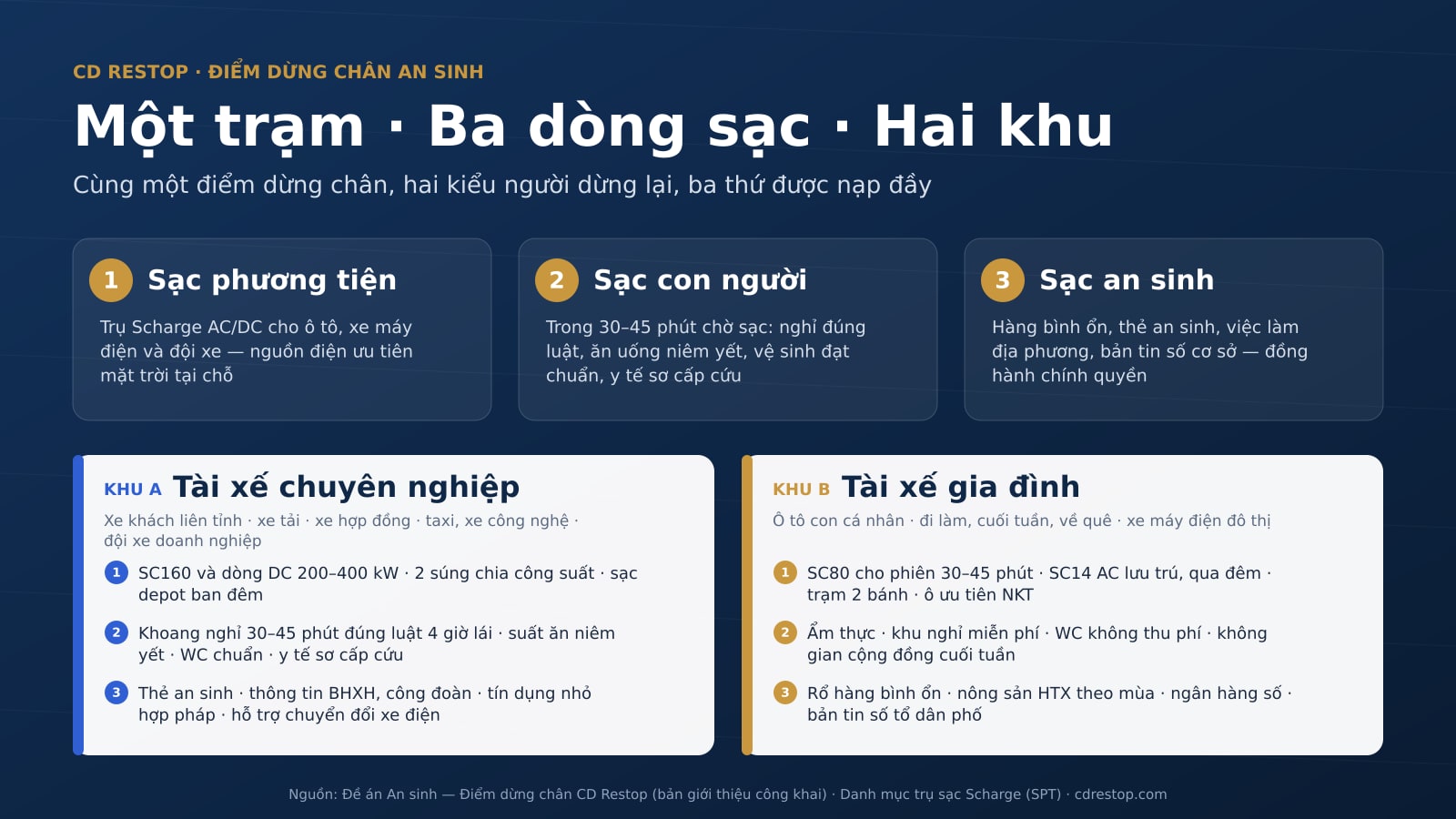
That gap comes from two different "clocks" carried by two kinds of people who stop — one measured in law and output, the other in journey and comfort. This article takes the "One station — Three charging streams" framework (vehicle charging · human charging · welfare charging — in the scheme's full wording: electric vehicle charging, worker health recharging and community welfare charging) onto the ground hour by hour, to see how the three streams must be "packaged" differently for two segments, why those two segments need two separate zones, and why they still share one service block.
Two clocks in the same car park
Professional drivers — coaches, trucks, taxis and ride-hailing cars, corporate fleets — stop by two overlapping clocks. The first is the law: Article 64 of the Law on Road Traffic Order and Safety No. 36/2024/QH15 caps continuous driving at 4 hours — a limit that Law No. 118/2025/QH15 keeps unchanged. The second is output: every minute the vehicle stands still is a minute that produces no trip. The law forces a stop; output forces the stop to be as short as possible.
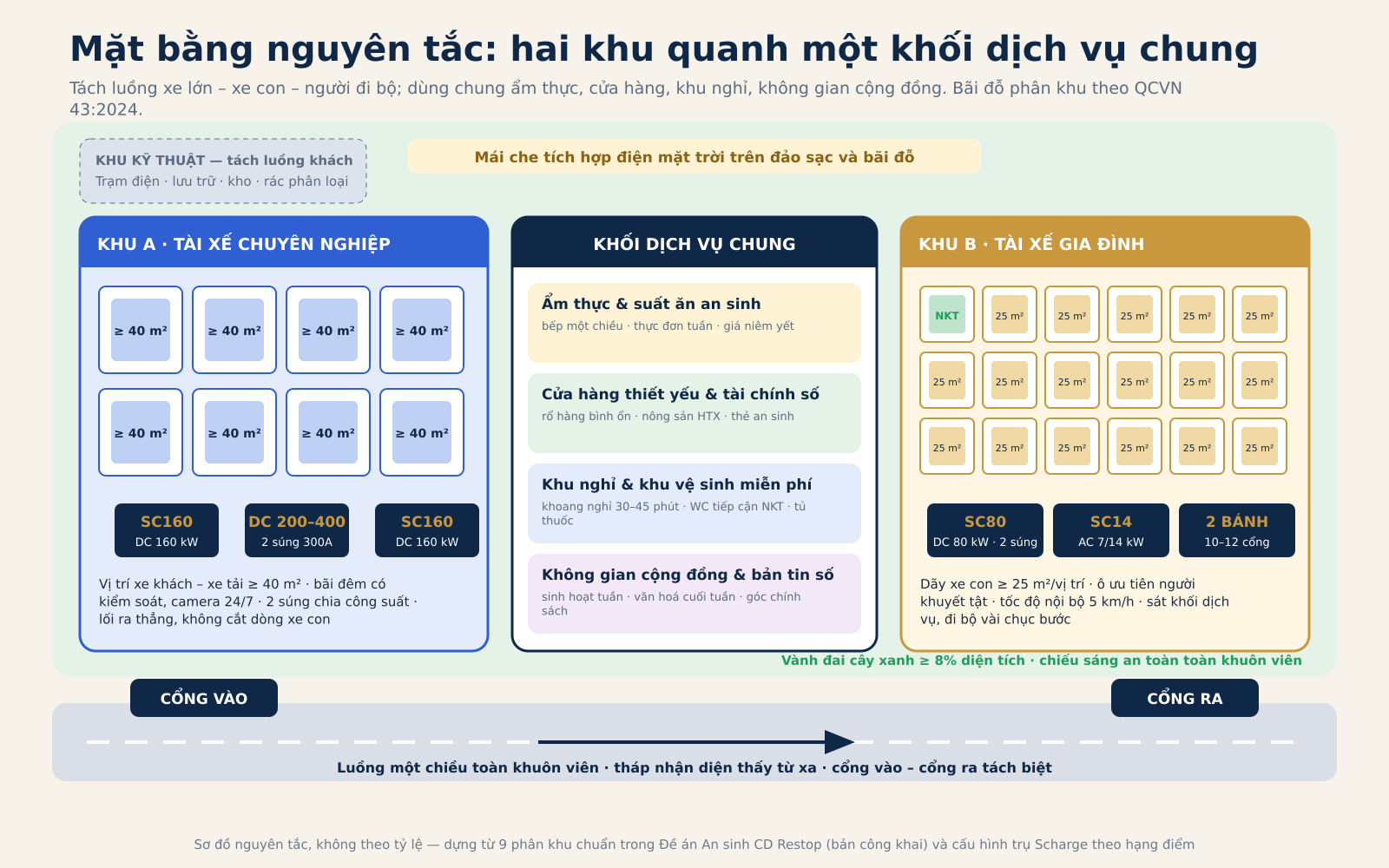
Family drivers — passenger cars used for commuting, weekends, trips home, with young children and the elderly on board, and in cities electric motorbikes too — carry an entirely different clock: the journey. This group accepts a 30–45 minute stop on one condition: there must be something to do during it. The price of one extra minute of waiting also differs: for the professional driver it is direct, measured in trips and shifts; for the family it is indirect, measured in experience and return visits. From this come four differences that no clever layout can erase: vehicle size and traffic flow; charging power and duration; rhythm through the day; the expected experience.
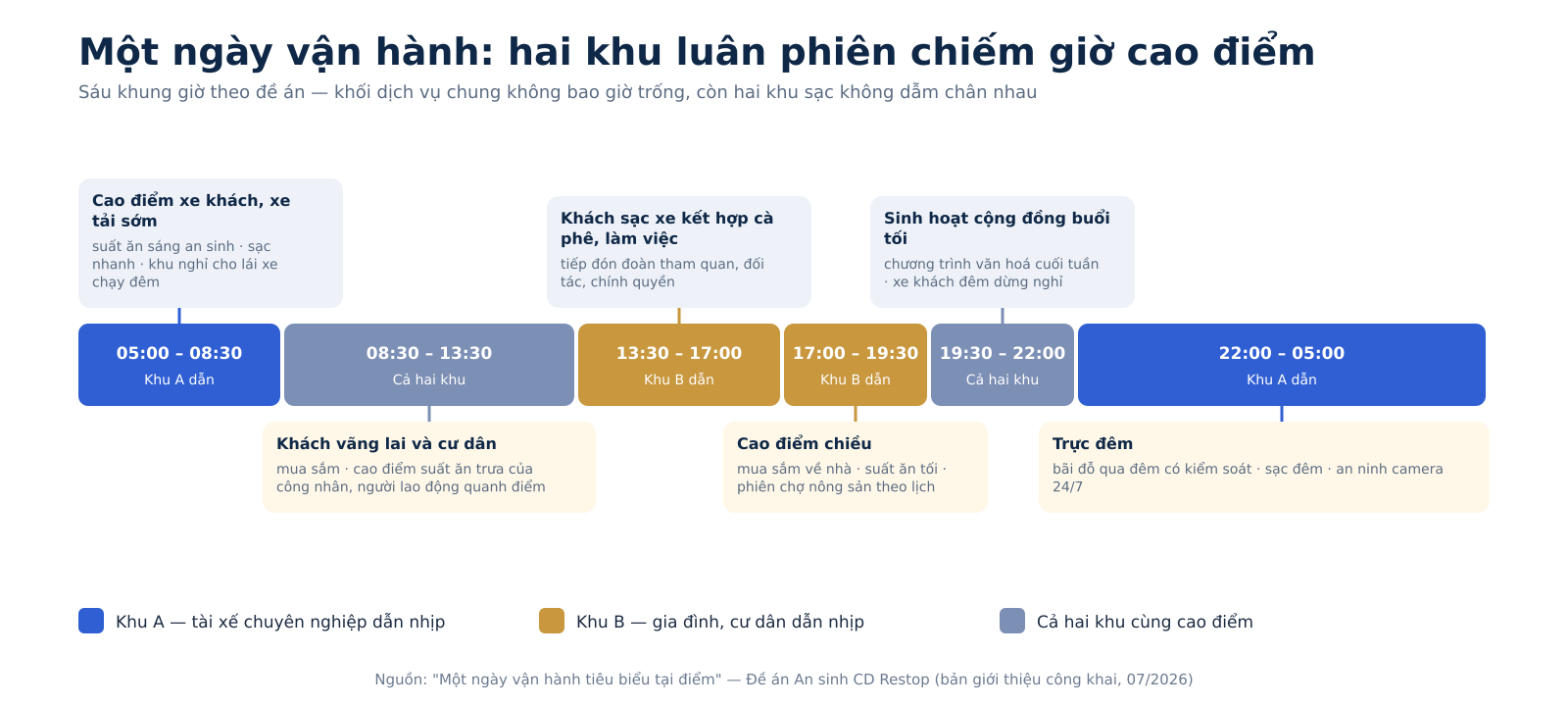
05:00–08:30 — Zone A opens its shift: three charging streams for professional drivers
The first slot of the day, under the scheme, is the peak for early coaches and trucks: welfare-priced breakfast meals, fast charging, a rest area for drivers who drove through the night.
Vehicle charging: buying time with power, buying output with rhythm
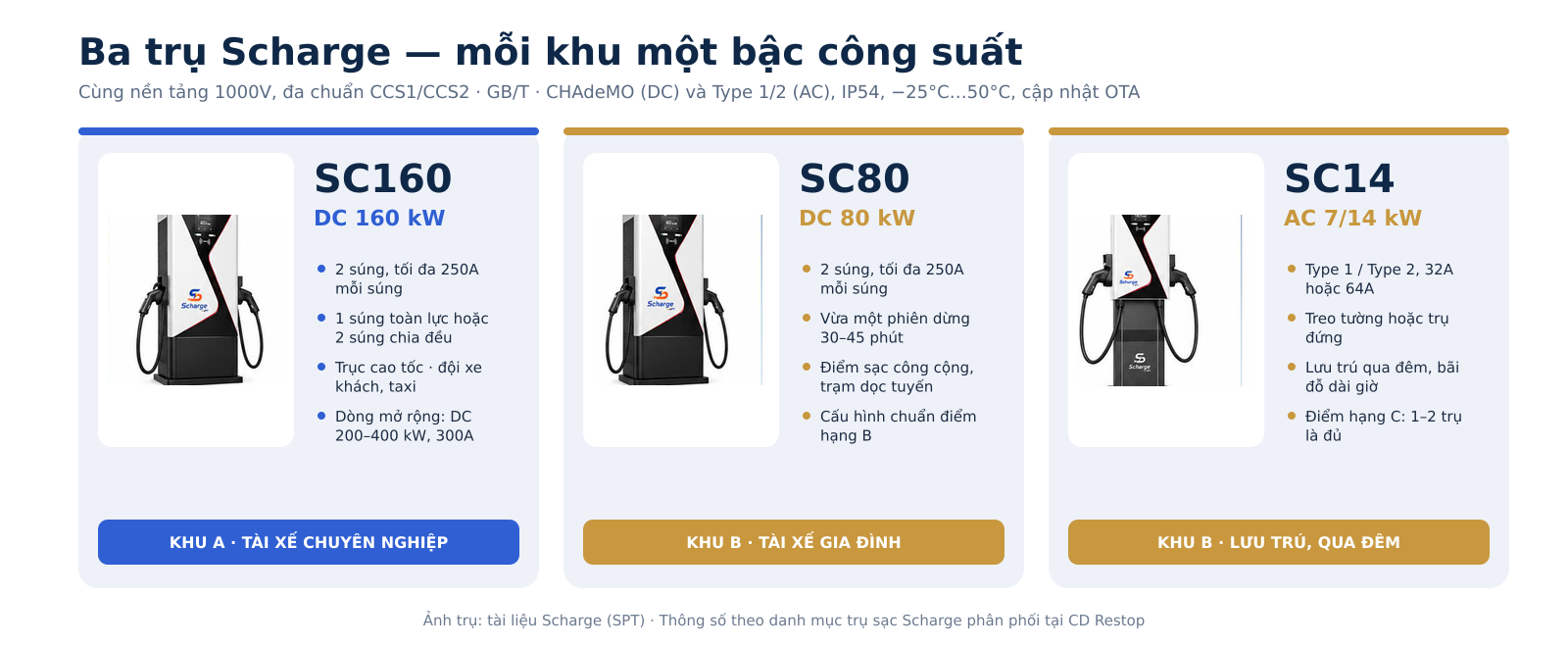
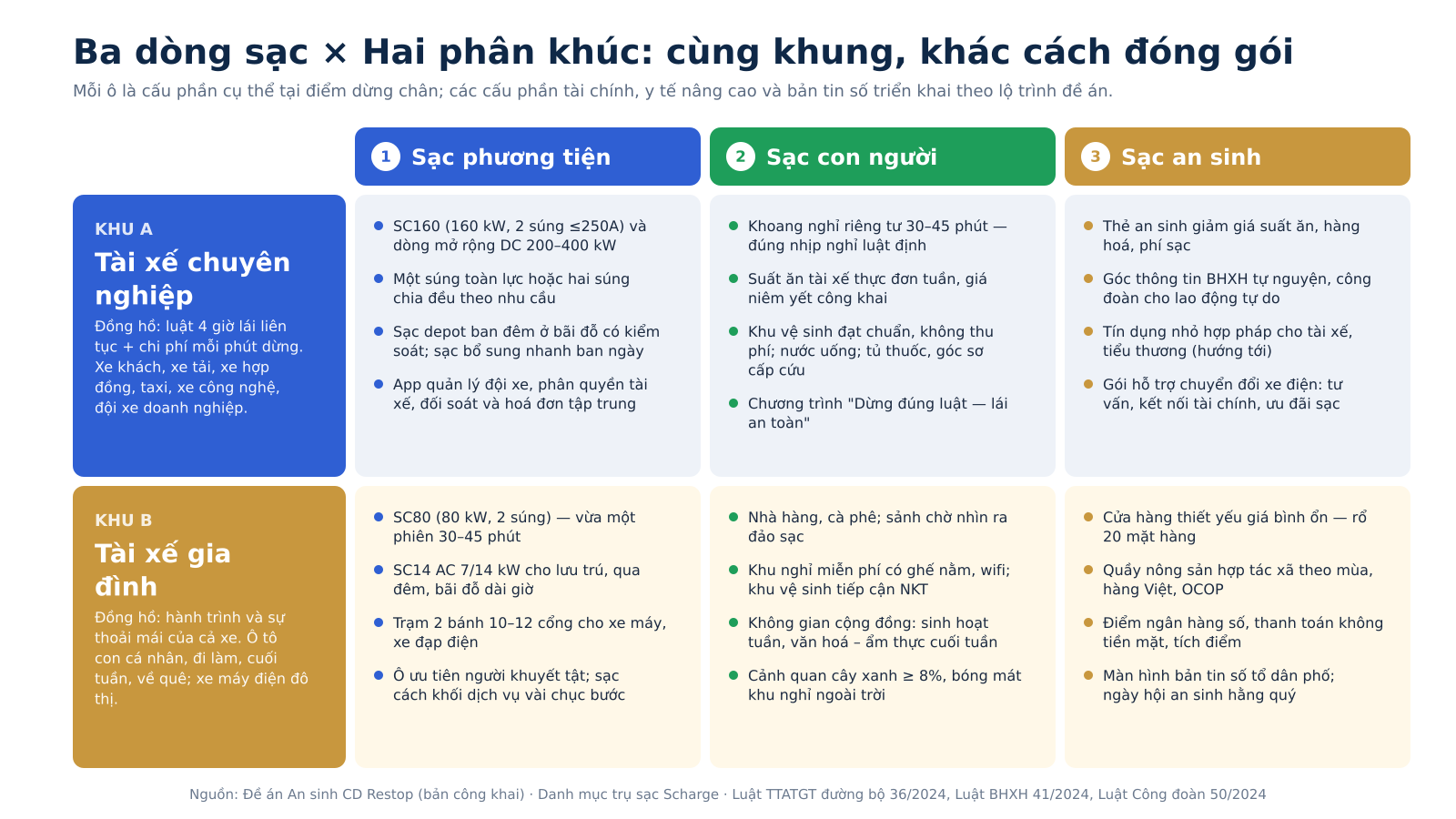
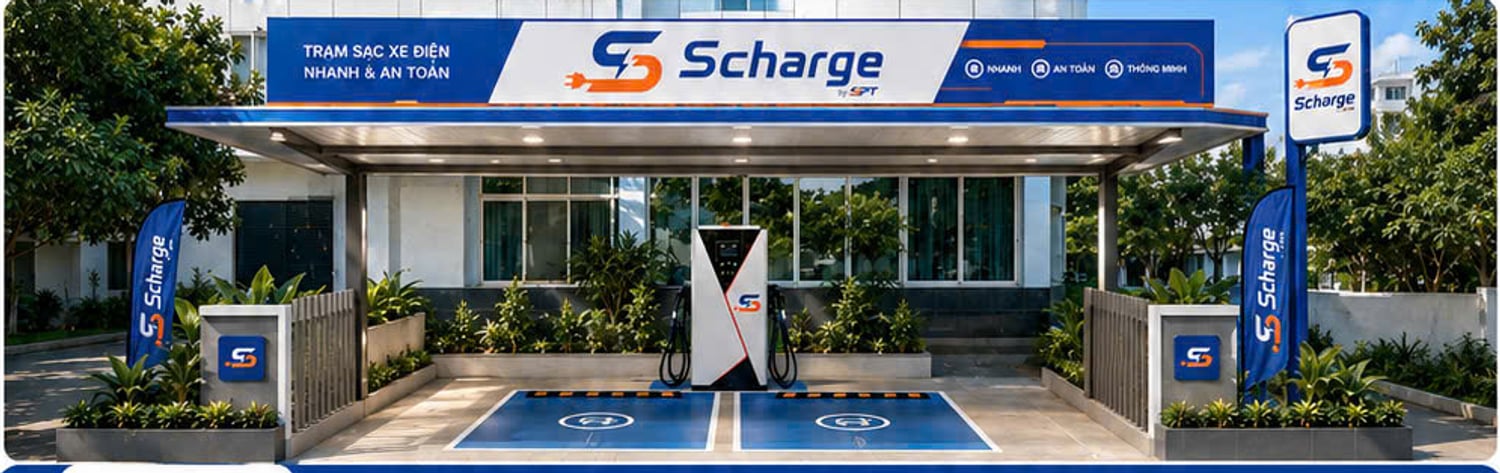
Zone A's question is very narrow: how can a 45-seat coach or an electric truck take on a meaningful amount of energy within exactly the statutory rest break. The answer is the top power tier of the Scharge range: the SC160 charger — DC 160 kW, one gun receiving the full 160 kW or two guns sharing it equally — and the extended DC 200–400 kW line with a mode where two guns charge one vehicle in parallel, for 45-seat electric coach terminals, truck fleets and route coaches. Electric coaches and trucks are the rare group for which 160 kW on the cabinet is 160 kW into the battery — for them, buying power is buying exactly what they pay for.
Power is only half; the other half is rhythm. The transport segment generates the steadiest charging output thanks to two rhythms: night-time depot charging on low-power units and top-up fast charging along the route by day; Zone A serves both. For fleets returning in shift waves, Zone A is counted by the number of vehicles plugged in at once, not by total kW on the cabinet: ten vehicles arriving together need ten positions, not one very powerful charger. On-site energy storage lets the station absorb the wave without registering grid capacity at a level used only a few hours a day.
The third layer is software — for fleets, software is an accounting tool before it is a charging tool: the operator needs to know which driver charged how much and where, to reconcile and receive one consolidated invoice instead of a stack of receipts. This is an item Zone A must budget for. The commitment to 97% or higher operational availability therefore matters more in Zone A than anywhere else: a broken charger here makes a coach miss its schedule.
Human charging: a rest break in the right place, within the law
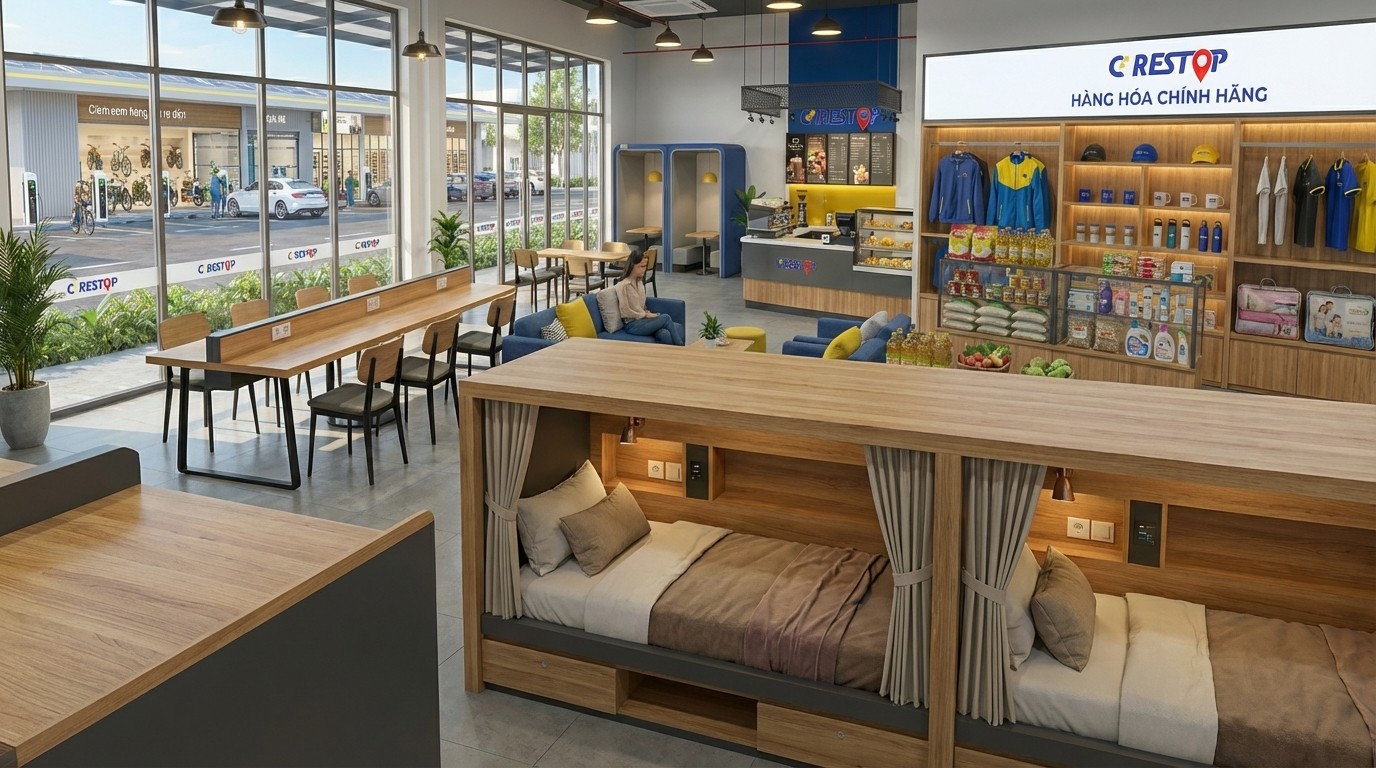
A driver stepping out after a night shift needs three things, in this order: restrooms that meet the standard, a place for a short sleep, a hot meal at a price known in advance. Surveys on expressways show that the need for a short sleep in a dark, quiet, air-conditioned space is almost entirely unmet. The second charging stream in Zone A fills precisely that gap: a free private rest pod for 30–45 minutes for long-haul drivers, free restrooms inspected every shift, a worker–driver meal counter with posted prices, a first-aid corner.
Why must the rest pod be a separate item rather than a few chairs in the shared lobby? Because when Law 118/2025 removes the daily and weekly driving-hour ceilings from 1 July 2026, the burden of guaranteeing rest shifts to the transport operator's work organisation and to roadside infrastructure: an operator with a map of stops that have rest pods can schedule legal rest more easily than one with only a clock. A short sleep in a private pod with a bed and mains power, without idling the engine to run the air conditioning, is a road-safety item. The scheme's "Stop by the law — drive safely" programme — aimed at distributing rest-stop maps at bus terminals and transport operators — will give the mandatory break a specific address.
Welfare charging: a safety net for mobile workers
The third charging stream in Zone A targets informal workers in the transport sector — a group the formal safety net has only just begun to reach. The Law on Social Insurance No. 41/2024/QH15 widens coverage and adds maternity benefits to voluntary social insurance; the Law on Trade Unions No. 50/2024/QH15 opens union membership to people working without an employment relationship; the Law on Employment No. 74/2025/QH15 sets up a framework for job and skills support. These people have no HR department to ask. They have a rest stop.
So in Zone A, welfare charging is packaged into things that can be completed in a single stop — most still at the scheme's planning stage: a welfare card used across the whole network, aimed at discounts on meals, goods and charging fees, registered on site with data consent under Law No. 91/2025/QH15; legal micro-credit for drivers and small traders with licensed credit institutions, aimed at pushing back informal lending; an information corner on voluntary social insurance, social pensions and union rights; and an EV transition support package — vehicle advice, financing connections, charging incentives — in response to Directive 20/CT-TTg.
Why place it in the professional drivers' zone rather than the shared lobby? Because their clock allows no searching: a counter you have to look for is a counter nobody visits. The three streams thus form a chain: vehicle charging brings commercial vehicles in by shift, human charging keeps the driver for one stop, and welfare charging — once the welfare card is activated — will give them a reason to return to this exact station.
08:30–17:00 — Zone B takes over: three charging streams for family drivers
When the early coaches leave the yard, the rest stop changes tempo. The 08:30–13:30 slot is passing travellers and local residents shopping, with the lunch peak for workers around the site; 13:30–17:00 is customers charging their cars while having coffee and working.
Vehicle charging: SC80 for the stop, SC14 for overnight stays, two-wheeler station for the city
A passenger car pulling into a highway-side station does not need 160 kW. For a mainstream car, the power actually received is limited by the car itself, not the charger — the article on choosing chargers by power worked through that arithmetic; here only the conclusion is needed: 160 kW does not materially shorten a family car's charging session. A passenger car's top-up need is 20–30 minutes; a family's natural stop is 30–45 minutes. The SC80 charger — DC 80 kW, two guns, two power modules allocated flexibly — fits that window exactly: fast enough for the session to end with lunch, compact enough to cover many positions.
But Zone B is not only 30-minute visitors. At sites with lodging or long-stay parking, installing DC means leaving an expensive asset idle all night; the SC14 charger (AC 7/14 kW, Type 1 and Type 2 connectors) covers this group: SC80 next to the lobby for short visits, SC14 in the long-stay car park. The third component is a two-wheeler charging station for electric motorbikes, e-bikes and delivery riders at urban sites, separated from the car chargers because someone wheeling a motorbike to a socket should not stand in the same yard as a car reversing into a charging bay. By the same logic, the passenger-car rows follow QCVN 43:2024/BGTVT at a minimum of 25 m² per bay, and the scheme's layout adds priority bays for people with disabilities and an internal speed of 5 km/h — because small children open car doors and the elderly step out at walking pace.
Human charging: something to do during one stop
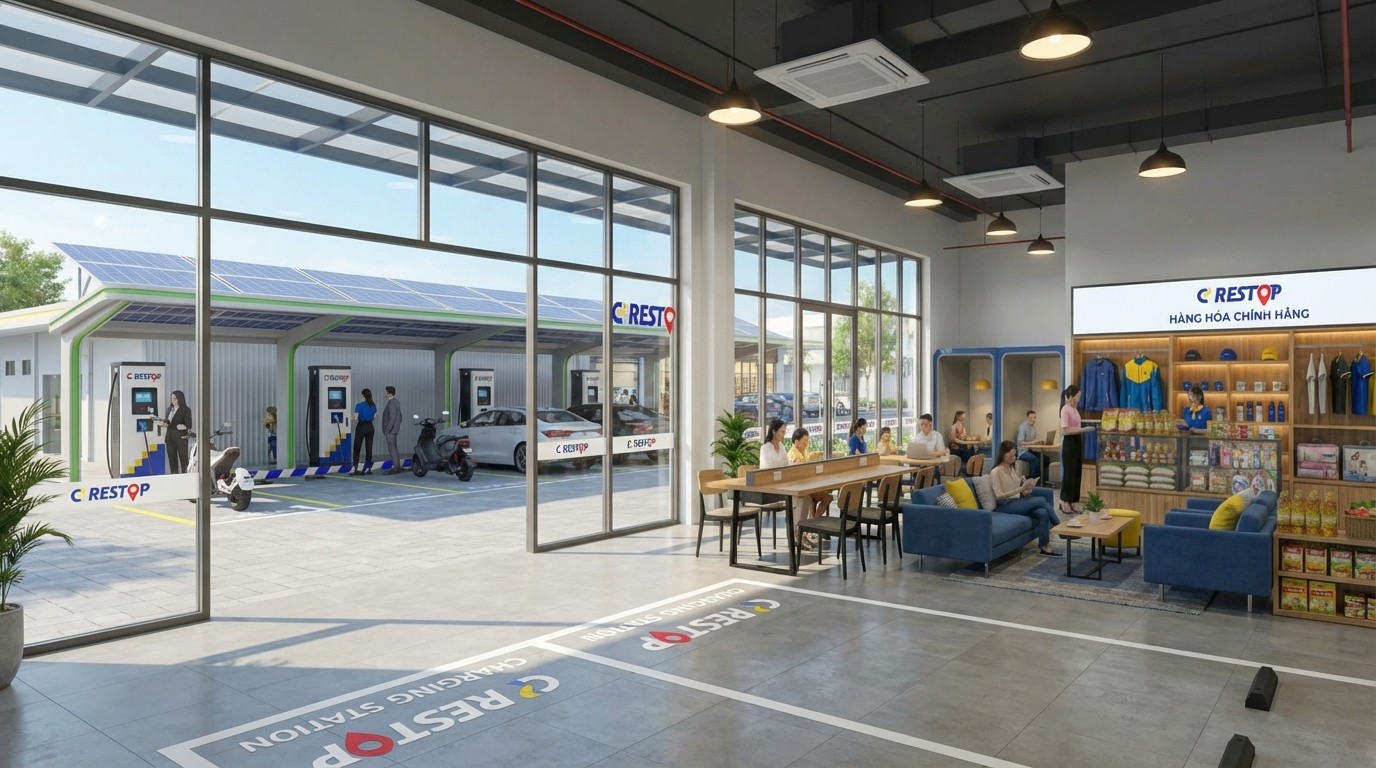
In Zone A, human charging answers the question recover to keep driving safely. In Zone B, the question is are these thirty minutes worth it. A family is usually not forced to stop — they stop because they want to. So the second charging stream in Zone B is a chain of experiences, not a list of amenities: a free rest lounge, free restrooms that meet the standard and are accessible to people with disabilities, a food block with a one-way kitchen, work seating with wifi — arranged into a path that never doubles back: out of the car — restrooms — eat — shop — rest — back to the car.
A family is not afraid of 30 minutes; they are afraid of not knowing whether it is 30 or 60. So human charging in Zone B starts before the car turns in: gun status must be visible in the Scharge app, so that the decision to stop at this station is made on the road, not at the gate.
Welfare charging: the rest stop as an institution of the neighbourhood around it
Zone B has a group of customers Zone A does not: people who are not charging a car. Residents around the site, workers at lunch, small household businesses, the elderly — for them the rest stop is an address in the ward or commune. After the two-tier local government reorganisation from 1 July 2025 — 34 provinces and cities and 3,321 commune-level units — each ward or commune covers a larger area than before; a staffed civic facility at the gateway becomes a relay point for grassroots information.
The third charging stream in Zone B is therefore packaged for the community: a price-stabilised essentials store with a basket of 20 staple items, a commitment that prices are no higher than the local average, with quarterly public comparisons; a seasonal cooperative farm-produce counter, prioritising home-province produce and OCOP products; a multi-purpose room for weekly activities with the trade union and mass organisations, and a weekend cultural events yard. Two components remain at the planning stage: a digital banking service point at larger sites, aimed at opening accounts and issuing cards for the unbanked; and a digital neighbourhood bulletin screen — public content supplied and approved by local government and mass organisations, with the company only operating the display infrastructure.
Why do these components belong to Zone B? Because they need stop times that can stretch, slow pedestrians, children and the elderly — putting a farm-produce market next to a truck yard is putting it in the wrong rhythm. And because the mechanism here runs in reverse: in Zone A, welfare charging brings the driver back; in Zone B, welfare charging creates traffic that does not depend on electric vehicles — resident traffic, steady all week, arriving even when there is no holiday — the traffic that flattens the load curve in a way a pure charging station never can.

17:00–22:00 — the shared service block carries both zones
The 17:00–19:30 slot is the evening peak: shopping on the way home, dinner meals, the scheduled farm-produce market. The 19:30–22:00 slot is evening community activities — and night coaches begin stopping to rest. This is the clearest stretch of the day when both zones are busy at once: residents drop into Zone B for cooperative vegetables and a dinner meal; night-coach drivers enter Zone A to plug in, go to the rest pod and then out to the meal counter. If the service block leans toward Zone B, drivers have to cross the passenger-car rows in the dark; if it leans toward Zone A, families with small children have to walk past the truck yard. A central position, separate entrance and exit gates, one-way circulation — the only configuration in which the two streams of people do not cross at the busiest hour.
22:00–05:00 — the night belongs to Zone A, and to the power system
The last slot is the night watch: controlled overnight parking, night charging, 24/7 cameras. Zone B is all but asleep; for Zone A, this is the main working shift. Overnight truck parking is an item Zone B does not need and Zone A cannot do without: the scheme calls it controlled parking with posted fees — meaning staff on duty, cameras, and a clear boundary from the rest of the site. Drivers choose where to sleep by asking "who is watching my vehicle", not "how many kW is the charger".
The deeper reason sits in the switchboard: a site with only passenger cars sleeps from 22:00, but Zone A does not — fleets charging overnight are the only load that keeps the storage system and the solar roof busy for a full 24 hours rather than just a few peak hours. The night depot rhythm gives the four components — low-voltage power, rooftop solar, energy storage, smart chargers — enough operating hours to stand on their own. Circular 60/2025/TT-BCT for the first time establishes a separate retail electricity tariff group for charging stations and chargers with their own meters — the input electricity price for chargers becomes a transparent parameter instead of a gamble.
Within the announced alliance framework, this energy infrastructure has clear owners: Coro Energy PLC takes part in the two solar and storage components, alongside DTH Holdings on on-site electrical infrastructure and the energy management platform, SPT (Saigon Postel) with the Scharge charger system, and CD Restop developing and operating the station network. The investment cooperation signing ceremony scheduled for 9 September 2026 in Ho Chi Minh City will turn this structure from an intention into a formal commitment. For the two zones, this means the low-voltage supply for Zone A is built into the site's overall energy calculation from the survey stage, rather than added later.
Having gone round the clock once, the reason for separating the two zones has revealed itself; what remains is the reason they must still share one roof.
Why separate — and why still share
The table below sorts the reasons for separating the zones into four rows. The first — vehicles and traffic flow — is safety, non-negotiable. The other three are economics: merging the zones means buying high-power chargers for a group that does not need them and putting two experiences that cancel each other out in the same lobby.
| Criterion | Zone A — professional drivers | Zone B — family drivers | Consequence if merged |
|---|---|---|---|
| Vehicles and traffic flow | Coaches, trucks; bays ≥40 m²; large turning radius; one-way flow | Passenger cars ≥25 m², two-wheelers; priority bays for people with disabilities; 5 km/h speed | Large vehicles, small vehicles and pedestrians in one yard |
| Charging power and duration | SC160, DC 200–400 kW; multiple independent cabinets; short, steep sessions; overnight yard charging | SC80 for one stop; SC14 for long-stay parking; two-wheeler station | Passenger cars occupy high-power guns; coaches wait; low-voltage supply designed for the wrong peak load |
| Rhythm through the day | 05:00–08:30, 22:00–05:00 (and 19:30–22:00 shared) | 08:30–13:30, 13:30–17:00, 17:00–19:30 (and 19:30–22:00 shared) | Merging loses the advantage of alternating peaks |
| Expected experience | Short sleep, hot meal, safe overnight parking, labour policy information | Something to do, cleanliness for children and the elderly, shopping, community | Driver rest pods next to the weekend cultural events yard — neither is usable |
Separating the zones also gives dynamic power allocation a clear priority rule: vehicles about to depart with low batteries in Zone A, long-stay vehicles in Zone B.
So why not split them fully into two sites? Because of two opposite reasons, no less strong. The first is the service block — one kitchen, one restroom block, one multi-purpose room, one night shift — shared by both customer streams.
The second is the scheme's "self-sustaining welfare" mechanism: a share of the site's commercial revenue is set aside as a separately accounted welfare budget, spent on the free rest area, free restrooms, meal subsidies and the essentials basket. The free rest pod in Zone A is fed by the coffee and the basket of goods sold in Zone B; the price-stabilised basket in Zone B holds its price thanks to the steady charging output of the fleets in Zone A.
That mechanism comes with a layer of accountability: quarterly welfare reports sent to local government and mass organisations, community activity minutes confirmed by the co-organising party, and from 2028 the key indicators published on the website; on the operations side, charger availability of 97% or higher and a response to every complaint within 48 hours. Splitting into two addresses cuts off the cash flow that feeds each side.
In short: separate the two zones so that nobody waits for anybody; share one block so that no charging stream has to feed itself.
Scaling down: four tiers of site
The scheme standardises four sizes; the question is which zone shrinks first when the site gets smaller.
| Size | Area · location | Zone A | Zone B | Recommended charger configuration |
|---|---|---|---|---|
| Complex | 3,000–5,000 m² · major hub | Full: overnight yard, multi-cabinet DC cluster, farm-produce warehouse and transshipment with postal and logistics partners | Full: SC14 row, multiple two-wheeler clusters, multi-purpose room ≥100 seats, events area | Multi-cabinet DC 160–400 kW cluster + SC14 row + 12-port two-wheeler station × n |
| Tier A — flagship | 1,500–3,000 m² · regional hub, urban | Full, per the 9-sub-zone design set | Full | SC160 (or DC 240–400 kW for coach and truck fleets) + SC80 + 2–4 SC14 + 10–12-port two-wheeler station |
| Tier B — standard | 500–1,500 m² · urban gateway | Reduced: chargers shared by both streams, short rest area; no separate overnight yard | Core kept: quick F&B, welfare goods shelf, community corner | SC80 + 2 SC14 + 10-port two-wheeler station |
| Tier C — affiliated | Existing premises owner | Almost none: rest area and standard restrooms shared | Minimum: service counter, free drinking water, policy notice board | 1–2 SC14 (+ SC80 as needed) |
The pattern is fairly clear: as area shrinks, Zone A shrinks first and faster than Zone B. The reason lies in the 40 m² bay: a coach and truck yard with a controlled overnight area does not scale down proportionally — it is either there in full or not at all. Zone A is the most land-hungry zone on the whole site. Zone B, by contrast, can be trimmed step by step — fewer SC80s, the multi-purpose room shrunk to a community corner — while keeping the core of the three charging streams.
The real sites sit on rungs of the table above: CD Restop Cienco 68 — Tier A, site under development; CD Restop Nguyễn Hoàng — Tier B, 1,800 m², 6 DC chargers, in operation; CD Restop Căn tin Khu Công nghệ cao (High-Tech Park Canteen) — Tier C, 400 m², 2 DC chargers, in operation. The two-zone configuration at each site follows the area of its tier.
Both zones fall due at once: 1 January 2027
Why not build Zone B first — passenger cars are far more numerous — and add Zone A once the commercial EV fleet is large enough? Because both are already due at the same time. The two groups are not the same size: by the end of May 2026 the whole country had only 3,396 electric trucks and 1,571 electric buses, while more than half of newly registered passenger cars were already new-energy vehicles. Yet the smaller group is the one that generates the steadiest charging output, and fleet depots still lack multi-brand charging infrastructure — two reasons why Zone A is not an add-on for later. Decree 51/2025/ND-CP waives the first-time registration fee for battery electric vehicles until 28 February 2027 — a window both groups are using.
The legal side of the premises does not allow zone-by-zone construction either. The Law on Roads No. 35/2024/QH15 defines rest stops as road infrastructure works and requires them to have an electric charging system; QCVN 43:2024/BGTVT requires a minimum of 10% of parking bays for EV charging — calculated on total bays — with a deadline of 1 January 2027 for existing stations, as the expressway survey article analysed.
A station that puts chargers only in the passenger-car rows meets the number but misses the substance, because the group required by law to stop has no gun at all. The expressway survey article explained why the 1 January 2027 deadline forces the low-voltage decision to be made this year; what this article adds is that the decision cannot be split by zone — the transformer substation is registered only once, for both. This is why the four investment components must be designed together from the survey stage, for both zones at once.

Takeaways
Four points remain after one turn of the clock.
One, two clocks, not two vehicle types, are the reason for separating the zones. Professional drivers stop by the 4-hour continuous-driving law and by output; family drivers stop by the journey and by comfort.
Two, the three charging streams are a chain, not three services. Vehicle charging brings customers in, human charging keeps them for one stop, welfare charging — once the welfare card is activated — gives them a reason to return; each link is packaged differently in each zone.
Three, the service block in the middle is a mechanism, not a floor plan. The two zones take turns holding the peak so that one kitchen and one shift have work all day; the welfare budget can only sustain the free rest pod and the price-stabilised basket when the traffic of both groups is added together.
Four, when scaling down, Zone A shrinks first; when building new, both must be designed at the same time. The 40 m² bay does not shrink proportionally, but the low-voltage supply must be sized for both zones from the first drawing.
Contact
Premises owners, transport operators and local authorities interested in the two-zone model can send details of their current site to hi@cdrestop.com or the hotline 0981 107 900 for CD Restop to survey the site and propose a configuration. Specifications of the Scharge chargers are published at cdrestop.com/vi/scharge; learn more about CD Restop's An Sinh model at cdrestop.com.
See how charging zones are laid out across the four rest stop tiers on the Scharge stations page.