
📋 Article outline
Twelve hours on the road, and VND 298,000
On 12 September 2026, driver groups in Ho Chi Minh City and Hanoi called on each other to switch off the app for two days to protest the platforms' deduction rates. Sài Gòn Giải Phóng newspaper quoted one driver: 17 trips in about 12 hours, revenue of 1.2 million VND, VND 949,000 deducted, leaving VND 298,000 take-home. We have no way to verify each figure on his phone screen. But we know one thing for certain: he was on the road for 12 hours.
Where did those twelve hours take place? On roadsides, under overpasses, in front of convenience stores, in sidewalk coffee shops. None of these places was built for someone working a 12-hour shift. This article is about that gap: what kind of rest stop informal workers in the center of major cities need, what data points to that need, and what part of it can be done now, without waiting.
Half the city is working without a contract
According to a press release dated 3 July 2026 from the National Statistics Office (Cục Thống kê), the country had 52.7 million employed people in the second quarter of 2026, of whom the informal employment rate was 61.7%. In urban areas, that rate was 47.1%. In other words, for every two people working in a city, nearly one has no labor contract, no compulsory social insurance, and no fixed workplace to rest between shifts.
App-based drivers and delivery riders are the most visible group within it. Xây Dựng newspaper, on 15 September 2026, cited figures from the Ho Chi Minh City Federation of Labour: the city has about 400,000 app-based drivers and delivery riders. Around the same time, the Labour Consulting and Support Center under the Ho Chi Minh City Federation of Labour, together with Ho Chi Minh City Social Insurance, surveyed 141 drivers. The results were published by Thanh Niên and VnExpress on 15 and 16 September 2026:
- 93.6% consider driving for a platform their main occupation.
- 46.1% drive 8 to 10 hours a day; 35.5% regularly drive more than 10 hours.
- To reach about 15 million VND a month, drivers must drive 13 to 15 hours a day.
- 73.8% have had a collision or accident while working.
- 88% want a mechanism to join compulsory social insurance; 93% want their occupation to be formally recognized.
Another VnExpress analysis in September 2026 cited research on full-time two-wheel drivers: average income of 11.07 million VND a month, down to 9.29 million VND after costs; working 11.1 hours a day, 28 days a month, or about 311 hours a month. For comparison, the average income of workers nationwide in the second quarter of 2026 was 9.0 million VND a month according to the National Statistics Office, for far fewer hours worked. Drivers do not earn more than other workers. They simply spend more hours on the road.
These days: commissions, and what stays the same no matter where they land
We want to be clear about our scope here, because this is where things can easily be overread. We are not a ride-hailing platform, not a party to the dispute, and not an arbiter of commission rates. We are only recording facts that have already been made public, along with the nature of each figure.
The deduction rate platforms disclose to drivers falls between 20% and 27%, according to VOV Giao thông on 19 September 2026. The rate drivers report in their groups and to the press is much higher, from 40% to 55% of what customers pay, because it adds platform fees and per-trip insurance fees, according to Thanh Niên on 9 September 2026. These two figures are not calculated the same way, and that is precisely why regulators stepped in. On 8 September 2026, the National Competition Commission sent a document and a meeting invitation, requesting that a platform provide materials on its fare, fee, and commission policies. On 15 September 2026, the Commission's Chairman confirmed this to the press. On 21 September 2026, the Vietnam Road Administration announced a review of transport businesses operating through technology apps, according to VTV.
There is no outcome yet from those meetings. But one thing will not change no matter where the commission rate ends up: tomorrow, that driver will still be on the road for 11 hours. The commission rate determines how much money he takes home. It does not determine whether he has a place to use the restroom at two in the afternoon.
Social insurance: a law being amended, and what can be done while waiting
Social Insurance Law No. 41/2024/QH15, effective from 1 July 2025, opened a door. Point a, Clause 1, Article 2 brings into the compulsory category people working under agreements known by other names, as long as the agreement reflects paid work under the management, direction, and supervision of another party. Clause 6 of the same article authorizes the National Assembly Standing Committee to decide on adding other categories based on Government proposals.
The door is open, but app-based drivers have not stepped through it. On 23 June 2026, Tuổi Trẻ quoted a response from the Ministry of Home Affairs: app-based drivers, delivery riders, and online sellers have not yet been added to the compulsory social insurance category, and are instead encouraged to join voluntary social insurance; the amended draft law is expected to be submitted to the National Assembly in 2026. On 18 September 2026, at a conference to gather comments on the draft amended law organized by the Ho Chi Minh City National Assembly Delegation, Deputy Head of Delegation Trần Thị Diệu Thúy proposed adding “people working on digital platforms” to Clause 1, Article 2, and Ho Chi Minh City Social Insurance agreed, according to Dân Trí on 19 September 2026. Earlier, from 31 July 2026, Đà Nẵng began subsidizing 15% to 30% of voluntary social insurance contributions under Resolution 84 of the city People's Council, targeting more than 10,000 workers in new occupations including app-based drivers and delivery riders, according to Người Đưa Tin on 12 August 2026.
We support that direction. But we also see the gap between a legal provision and a driver's afternoon. In the survey of 141 drivers mentioned above, most had household-based health insurance but no social insurance. To get them to register for voluntary social insurance, they need a place they pass through every day, with someone to explain it to them in person, a guide sheet on the table, a QR code to sign up on the spot. That place cannot be a government office. It has to be on the road they drive.

Physical needs: shelter, water, restrooms, a place to sit
On 6 April 2026, Thanh Niên reported that app-based drivers in Ho Chi Minh City were switching off the app from 11 a.m. to 2 p.m. because of the intense heat, accepting a 20% to 30% loss in income; some witnessed colleagues fainting on the road. Their request was very specific: public rest points with shelter, seating, and free drinking water, located at gas stations or convenience stores. In mid-September 2026, Hanoi saw heavy rain for several nights in a row; VietnamPlus reported flooding on many streets and prolonged congestion on 15 September 2026. Delivery riders have no option to switch off the app when it rains, because orders spike exactly then.
Others answered this need before we did. On 27 September 2024, the District 8 Federation of Labour launched a free rest stop of about 70 square meters inside a coffee shop on Tạ Quang Bửu Street: parking, restrooms, wifi, free iced tea. According to Người Lao Động, the Ho Chi Minh City Trade Union Social Work Center had by then coordinated the launch of 10 such rest stops for traditional and app-based motorbike taxi drivers. The model is simple and well placed. We take it as evidence that the need is real, and that existing premises in a city can become a rest stop for hundreds of people a day with just a few minimal components.
Class C affiliated stops: how we bring rest stops into city centers
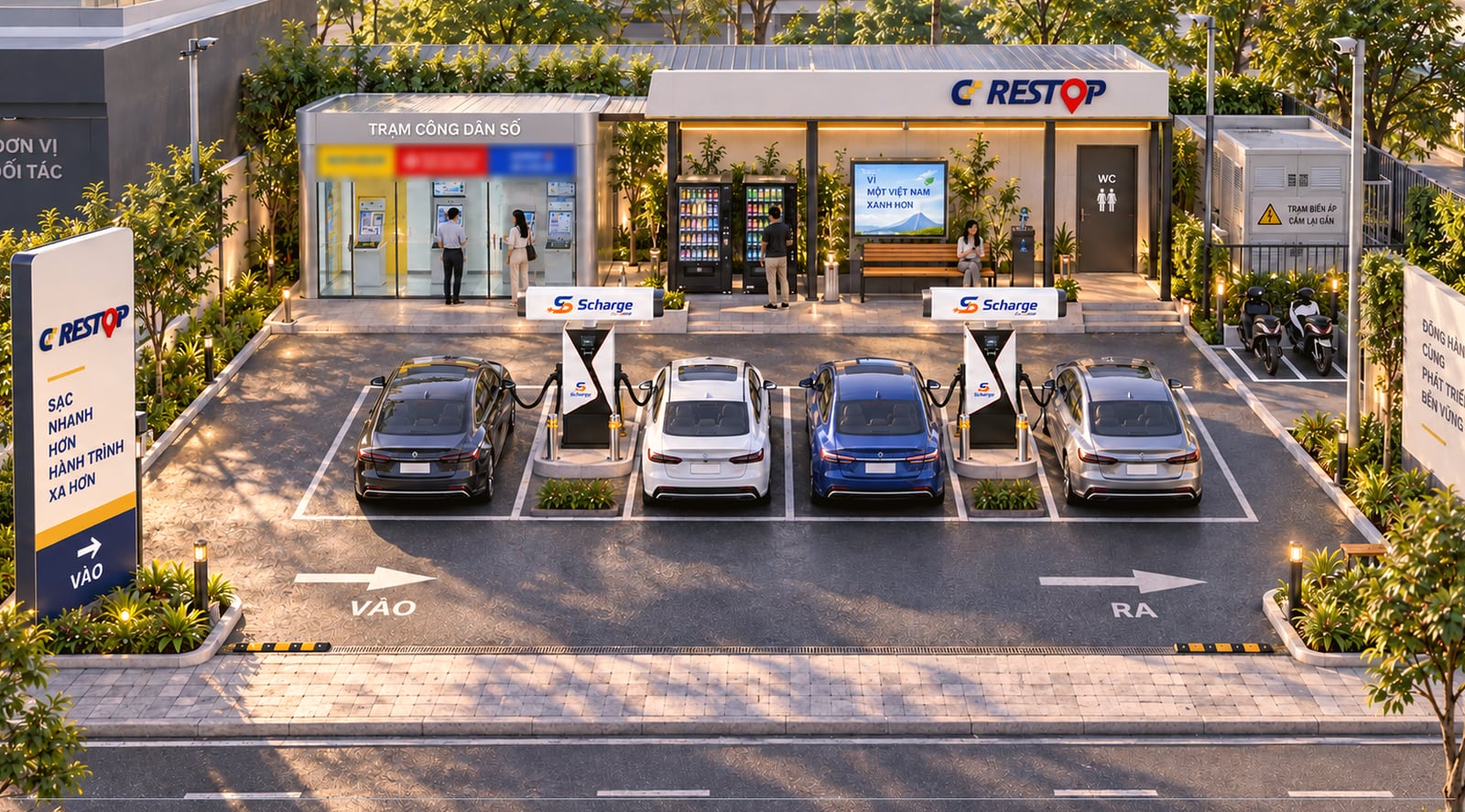
Our design standards define four classes of stops. Three larger classes require land: Complex, 3,000 to 5,000 square meters; Class A, 1,500 to 3,000 square meters; Class B, 500 to 1,500 square meters. City centers do not have land like that. That is why the fourth class, Class C, is designed to need no new land. It is an affiliated stop placed on a partner's existing premises: a gas station, a restaurant, a parking lot, a community hall, a local market, or a corner of a company's yard.
The minimum components of an affiliated stop still meet our full “Five HAVEs” standard, at the smallest scale: a service counter, a charging post, code-compliant restrooms at no charge, free drinking water, and a policy information board. An affiliated stop has its own electricity meter, does not draw off the partner's power supply, and has a clearly defined management boundary so it can be installed or removed as needed. We invest in the equipment, share revenue with the site owner, and operate it under the same set of procedures as the larger stops. Class C is not a scaled-down convenience store model. It is the fastest-replicating layer of the network, and the only layer that can reach into wards and communes.
For app-based drivers, the priorities at an affiliated stop in the city differ from those at a stop on a national highway. On the highway, charging posts and sleeping rooms come first. In the city, shade, seating, water, restrooms, and phone charging outlets come first, with vehicle charging after that. Most two-wheel drivers today still ride gasoline motorbikes; the affiliated stop serves them first as a place to stop, and stands ready for the day they switch to electric vehicles.
Who pays for what's free?
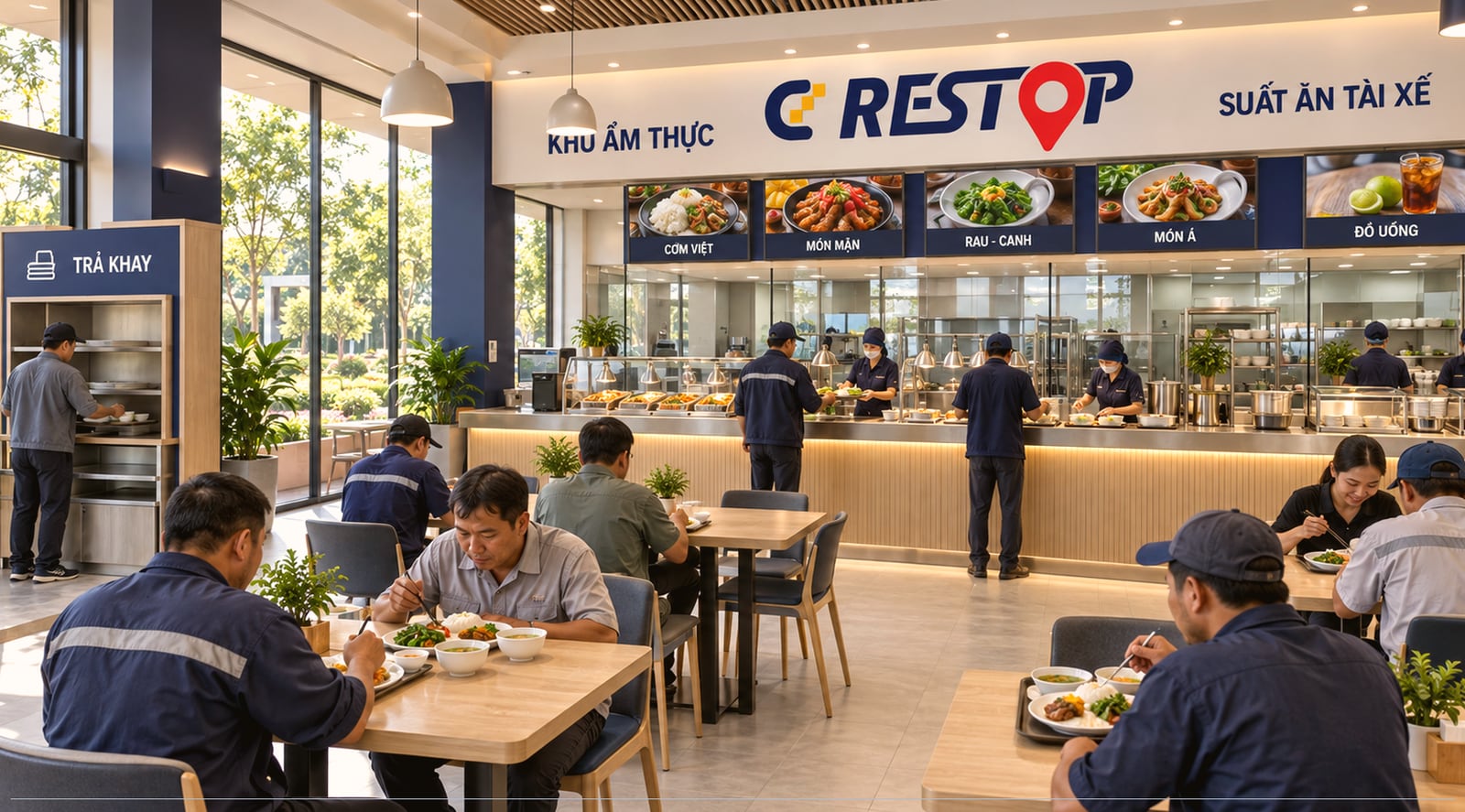
This question always comes up, and we answer it with a mechanism, not a promise. Commercial revenue at each stop, including retail, meals, charging services, and advertising, is set aside into a separately accounted welfare budget. That budget covers free restrooms, free drinking water, meal price subsidies, and community activities. Our proposal does not ask for public financial support. Local authorities enable this by introducing suitable premises and institutions; unions and mass organizations participate by co-organizing activities and monitoring commitments through quarterly reports.
We want to be clear about our own limits. A network of 34 provinces and cities, 500 rest stops, and 14,000 satellite charging points is the Scharge Project's target, not its current state. We do not yet have a stop operating in a city center. What we have is a completed set of design standards, four agreements signed on 9 September 2026 with partners covering the charging platform, equipment, land, design, and on-site services, and an eight-step process from securing premises to operation. The first stop will speak for itself, better than any introduction.
An invitation
If you own a gas station, a restaurant, a parking lot, or a community hall in the city, you hold something that 400,000 people need: premises in the right place. If you are a union or association maintaining simple rest stops like the one in District 8, we want to learn how you do it and contribute equipment and procedures to make those stops more durable. If you are an agency drafting the amended Social Insurance Law, we are ready to turn every affiliated stop into a policy outreach counter, where a driver can register on the spot between two trips.
Two in the afternoon, 36 degrees, and a driver switches off the app because he cannot take it anymore. We want that when he pulls in, there is shelter, a glass of water, a clean restroom, a phone charging outlet, and on the table, a voluntary social insurance registration guide with someone ready to explain it. The commission rate is a matter for the negotiating table. The rest stop is our business.
For partnership on premises and collaboration, contact us: hotline 0981 107 900 · email hi@cdrestop.com.
Read more: Why rest stops must be standardized nationwide · Behind every wheel is a family.