
📋 Article outline
When a site owner or a transport business first starts looking at EV charging, the opening question is usually "which charger is the most powerful?" It is the right question at the wrong time. The hardware is only the visible layer of a bigger decision: who puts capital into what, who carries which risk, and who controls the driver's experience when they stop.
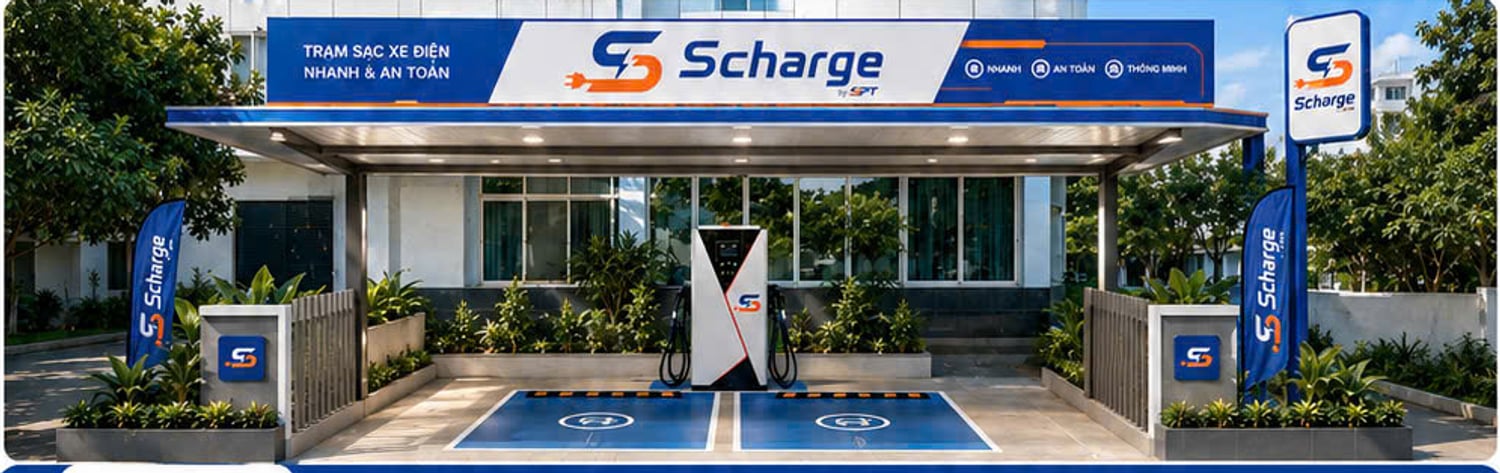
With the Scharge charging system — a brand of SPT (Saigon Postel), which supplies the chargers and the operating app platform — CD Restop is offering three ways into charging infrastructure: buy and self-operate, co-investment and joint operation, and enterprise charging stations for in-house fleets. These are not three variants of the same product; they are three fundamentally different structures for allocating capital and risk.
Four risks worth naming up front
The difference between the three models comes down to one thing: whose shoulders the following four risks land on.
- Traffic risk — the station is built, but not enough electric vehicles pass through the area to keep the chargers running regularly. This is the largest risk and the hardest to transfer, because it depends on how fast an entire region converts its vehicle fleet, not on the quality of the equipment.
- Technical and operating risk — a charger throws a fault, the connection drops, a customer mid-session has to call for support at midnight. Charging is a 24/7 service: a faulty charger left unresolved for a few hours is a charger that loses customers for every session afterwards as well.
- Site legal risk — land lease term, zoning, construction permits, grid connection and registered capacity. Chargers can be removed, but the transformer and the low-voltage works are tied to the location.
- Technology obsolescence risk — connector standards change, newer vehicles need higher charging voltages, older software falls out of support. The equipment still runs fine mechanically, but it can no longer serve the generation of vehicles that has become the majority on the road.
Model A — Buy and self-operate: maximum control, heavy upfront capital
The partner buys genuine chargers and installs them on their own site; CD Restop surveys, installs, activates the units on the app and provides warranty support. All charging revenue at the station belongs to the partner.
Capital and risk
The partner funds the hardware and most of the on-site electrical preparation — low-voltage works, distribution panels and dedicated metering for the charging operation. It is a one-off investment, and the asset sits on their balance sheet.
In return, the partner carries almost all of the traffic risk: if the site sees fewer electric vehicles than expected, no mechanism shares the shortfall. Site legal risk is theirs as well. Technical risk, however, is substantially shared — the equipment is covered by warranty, the software and app are operated by SPT, and OTA updates are delivered through the IoT platform without any on-site intervention.
Control and cash flow
This is the model in which the partner controls the customer experience the most: where the chargers go, the canopy, the lighting, the waiting area, and the services offered while the customer charges. With a dual-gun DC 80 kW charger, the dwell time is long enough to become a commercial opportunity — and that opportunity belongs to whoever owns the site.
Cash outflow is concentrated at the start; after that, only electricity and maintenance remain, while inflow spreads out with throughput and is not shared with anyone. This is the structure of a fixed-asset investment: absorb the capital pressure first, earn the margin later. It suits site owners who already have spare electrical capacity, have staff on site, and already believe in the traffic at their own location.
Model B — Co-investment: light on capital, in exchange for revenue sharing
The partner contributes the site and the transformer; CD Restop invests in the chargers, construction, software, operations and sales. The two sides share actual monthly revenue as agreed.
Capital and risk
The partner contributes assets they already hold — the location and the power supply — rather than cash, so they do not have to pull working capital out of their core business to bet on infrastructure they have never operated.
Traffic risk splits naturally: if the station is quiet, both sides earn less. Sharing actual revenue, instead of a fixed fee, ties the two parties' interests together rather than setting them against each other. Technical and obsolescence risk transfer almost entirely to CD Restop and SPT — the party that owns the equipment is also the party with the incentive to upgrade it. Site legal risk still sits with the partner, and this is the point to review most carefully: the term of the partnership must fit within the term of the rights to the site.
Control and cash flow
Control is shared. The software experience — finding a station, paying by QR code, card, VIN recognition or the app — is determined by SPT's platform; the physical experience on site still depends on the site owner. That boundary must be agreed in writing, because most driver complaints land precisely in the overlap.
There is no upfront capital shock. Revenue per kWh is lower than in Model A, but it starts earlier and carries no depreciation obligation. In essence, the partner converts an idle asset into a recurring income stream, in exchange for giving up the upside margin.
Model C — Enterprise charging: optimised for a fleet, not open to the public
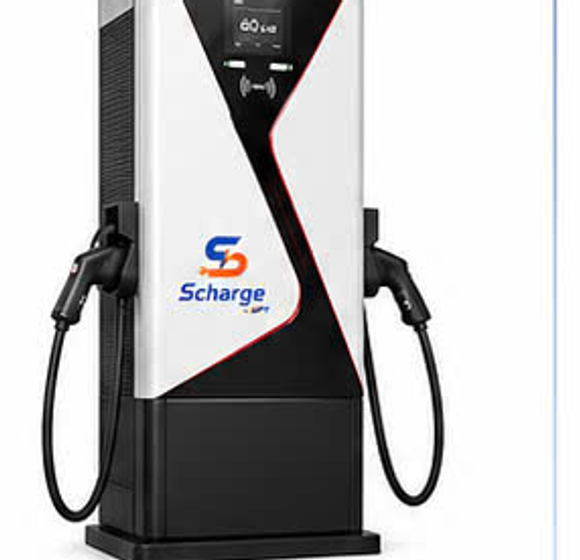
The third model is different in kind, because it does not target passing customers: CD Restop designs, installs and operates a dedicated station for the electric fleet of a transport, delivery or ride-hailing business.
Risk changes shape, it does not disappear
The business pays for a service; it does not buy an asset. Traffic risk is all but eliminated — charging demand is internal demand, calculable from the number of vehicles, daily mileage and operating shifts. In exchange, the risk takes another form: availability risk. A station that goes down early in the morning does not cost one customer; it keeps the whole fleet from leaving the depot. The contract must therefore state fault-resolution times explicitly, not stop at equipment warranty.
A distinct engineering problem
A fleet station rarely needs peak power at each individual charger; what it needs is to charge many vehicles simultaneously within a narrow time window. A common configuration is overnight AC charging — the SC14 line, 14 kW with two guns, Type 1 and Type 2 — combined with a few DC units for fast turnarounds between shifts. The focus is dynamic load management across the whole cluster: total consumption never exceeds the registered ceiling, yet every vehicle is fully charged before departure. Class 1 accuracy metering allows energy costs to be allocated per vehicle.
A limitation worth knowing: an enterprise station generates no external revenue — it is an optimised operating cost, not a profit centre. Anyone who wants to serve both their own fleet and passing customers should say so at the survey stage, because that requirement changes both the location and the equipment.
Five questions to ask yourself before choosing
- Does the site already have the electrical capacity? Without a transformer, or with a low registered capacity, the low-voltage works and the utility paperwork will account for a significant share of total investment and for almost all of the deployment time. This question determines whether Model A is feasible more than any other factor.
- How much traffic passes the site, and what share of it is electric? These are two different numbers, and both change over time. A location that is busy today but sits off the main corridors of fleet electrification can still be a weak site for charging infrastructure five years from now.
- How long do customers stay? A site where customers stop for a few minutes needs high DC power; a site where vehicles park overnight needs only AC chargers and saves most of the infrastructure cost. Choosing the wrong charger type for the dwell pattern is an expensive mistake and a hard one to undo.
- Is there an operations team on site? A charging station needs someone to handle very ordinary situations: a car blocking a charger, a tangled cable, a customer struggling with the app. A site with no staff on duty that chooses to self-operate takes on a cost that investment spreadsheets rarely reflect.
- Is the real goal charging revenue, or customer retention? For a rest stop, a shopping centre or an F&B chain, a charging station is often more valuable in its role as an anchor for traffic — the reason a customer stops here instead of driving on. If that is the case, maximising revenue per kWh is no longer the most important criterion, and the co-investment model usually makes more sense.
Worth saying plainly: this is infrastructure on a 5–10 year cycle
Charging infrastructure cannot be judged on a few months of operation. Revenue depends directly on EV density in the area — a variable outside the control of both parties. A station in the right place but a few years ahead of the adoption curve will still go through a long stretch of running below capacity.
The responsible way to handle this is to design for the future from the start, rather than investing piecemeal and rebuilding later: register electrical capacity with headroom for a 5–10 year roadmap; choose equipment built on a 1000 V platform with a 200–1000 V DC output range, so it is not ruled out of the game once higher-voltage vehicles become common; cover CCS1, CCS2, GB/T and CHAdeMO rather than betting on a single standard; and favour platforms with remote software updates, so that the part that dates fastest does not drag the hardware down with it.
It is also worth being realistic about scale. The network CD Restop is developing is at an early stage, with a number of stations operating in Ho Chi Minh City. Expansion plans are being formalised through co-investment agreements — the signing ceremony on 9 September 2026 between CD Restop, SPT, Coro Energy PLC and DTH Holdings marks the shift from intent to formal commitment, covering rooftop solar, BESS storage and an operations management platform. A partner joining today joins a network that is still taking shape, not a finished one — and that should be factored into expectations.
Choosing a model really means answering one question: over the next ten years, do you want to own an asset, share an income stream, or simply never have to worry about your fleet running out of charge?
Get in touch
No model should be chosen on paper. The process has three steps: send us your requirements and site details; CD Restop surveys the site and proposes a location and charger configuration; the two sides agree on a model, sign, and deploy.
Site owners, transport businesses and investors can send their details to hi@cdrestop.com. Technical specifications for the AC and DC charger lines are published in the Scharge section on cdrestop.com; investment cost information is provided according to the price list issued by SPT, following a site survey.
See the four partnership models for installing charging stations on the Scharge partnership page.